
Key Highlights
- Vision is one of three essential systems the body relies on to stay upright, alongside the inner ear and the body's sense of position in space.
- Age-related conditions like cataracts, glaucoma, macular degeneration, and diabetic retinopathy can quietly undermine balance long before total vision loss occurs.
- Older adults with vision impairment are roughly twice as likely to fall, and falls remain the leading cause of injury-related death in seniors.
- Simple interventions like updated prescriptions, better lighting, cataract surgery, and home modifications can dramatically reduce fall risk.
- Staying socially and physically active, with the right environment and support, helps preserve both vision health and mobility in later life.
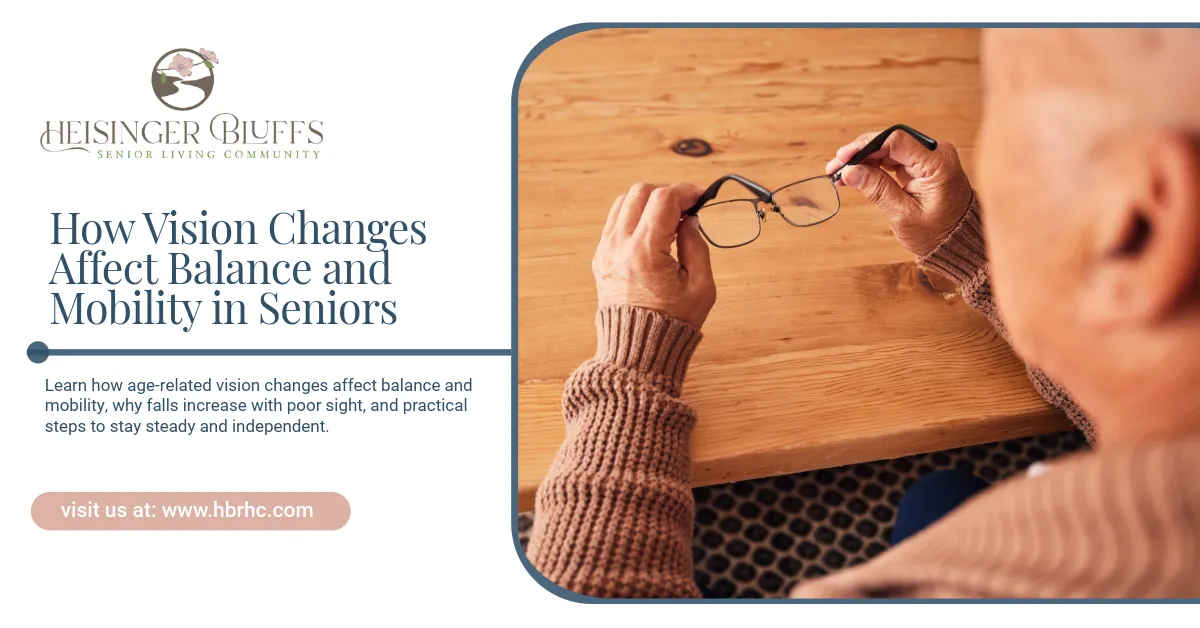
Most people think of vision as something separate from balance. We see with our eyes, and we walk with our legs, and the two feel like they belong to different parts of life. But the truth is that vision is one of the most powerful contributors to balance and safe movement, especially as we age. When sight changes, even subtly, the entire system that keeps us upright begins to shift.
For older adults, those shifts matter. They show up as a hesitant step on the stairs, a missed curb, a near miss in the kitchen, or a fall that changes everything. Understanding how the eyes, brain, and body work together to keep us steady is one of the most useful things a senior or family caregiver can learn.
The Three Systems That Keep Us Balanced
Balance is not a single sense. It is the product of three systems working in constant coordination.
The first is the vestibular system, located in the inner ear, which detects head movement and orientation in space. The second is proprioception, the body's awareness of where its limbs are without looking, communicated through nerve endings in the muscles, joints, and feet. The third is vision, which provides the brain with a constant stream of information about the surrounding environment, distance, depth, motion, and obstacles.
When all three systems are working well, the brain blends their input seamlessly. We do not have to think about staying upright; it simply happens. But when one system weakens, the others have to compensate. In older adults, this is where the trouble starts. The vestibular system tends to lose sensitivity with age. Proprioception declines as nerves and muscles change. And vision, the third leg of the stool, often weakens at the very same time. When all three falter together, balance becomes fragile.
How Vision Specifically Supports Balance
Vision contributes to balance in ways most people never notice until they are gone. Depth perception tells us how far away the next step is. Contrast sensitivity lets us see where the curb ends and the asphalt begins. Peripheral vision picks up movement at the edges, like a grandchild running across the room or a dog underfoot. Visual acuity helps us read signs, judge distances, and recognize hazards. The eyes also stabilize our gaze as we move, allowing us to walk without the world feeling like a shaky home video.
When any of these elements weaken, the brain receives less reliable information about the environment. The result is a kind of low-grade uncertainty with every step. The body may not feel afraid, but it moves more cautiously, less fluidly, and with more risk of a misstep.
Common Age-Related Vision Changes
Several conditions become more common with age, and each affects balance and mobility in distinct ways.
Cataracts are perhaps the most widespread. They cloud the lens of the eye, dulling colors, blurring detail, and increasing glare sensitivity. A senior with cataracts may find bright sunlight or shiny floors disorienting, and may struggle to judge curbs and steps accurately.
Glaucoma damages the optic nerve, often beginning with the loss of peripheral vision. Because central vision can remain sharp for years, glaucoma is sometimes called the silent thief of sight. Lost peripheral vision is especially dangerous for mobility, since obstacles, pets, and people at the edges of the field of view simply do not register until they are too close.
Age-related macular degeneration affects central vision, the sharp detail used for reading, recognizing faces, and seeing what is directly ahead. People with macular degeneration may navigate well in familiar spaces but struggle in unfamiliar ones, where reading signs and judging detail matter most.
Diabetic retinopathy, a complication of diabetes, can cause patchy vision loss, blurred sight, and increased difficulty with low-light conditions. Because diabetes itself affects nerve function in the feet, the combination of retinopathy and neuropathy is particularly hazardous for balance.
Beyond specific diseases, the aging eye also experiences general changes. Pupils become smaller and slower to adjust to changes in light. The lens stiffens, making it harder to shift focus between near and far. Tear production decreases, causing dryness that blurs vision intermittently. Each of these changes, individually small, adds up to a meaningful reduction in the visual information the brain can rely on.
How Common Vision Conditions Affect Mobility
| Vision Condition | Primary Impact | Mobility Risk |
|---|---|---|
| Cataracts | Cloudy vision, glare sensitivity | Misjudging steps, trouble in bright or shiny environments |
| Glaucoma | Peripheral vision loss | Bumping into objects, missing obstacles at the side |
| Macular degeneration | Central vision loss | Difficulty reading signs, recognizing terrain ahead |
| Diabetic retinopathy | Patchy or blurred vision | Unreliable depth perception, low-light hazards |
| Presbyopia and dry eye | Intermittent blur, focus delays | Hesitation on stairs, misreading distances |
The Link Between Vision and Falls
Falls are the leading cause of injury-related death among adults over 65, according to the Centers for Disease Control and Prevention. One in four older adults falls each year, and the consequences include hip fractures, traumatic brain injuries, loss of independence, and a measurable increase in mortality in the year following the fall.
Vision impairment is one of the strongest predictors of fall risk. Multiple studies have found that older adults with even mild vision loss are roughly twice as likely to fall as their peers with normal vision. Those with significant impairment face an even higher risk. The danger is not only the fall itself but the cascade that follows: fear of falling leads to reduced activity, which leads to muscle weakness, which leads to even worse balance and more falls.
In our experience, this cycle can begin almost invisibly. We worked with a resident who had moved in after a minor fall at home. She insisted her vision was fine, and her last eye exam had been three years earlier. After a comprehensive evaluation, she was diagnosed with moderate cataracts in both eyes. Following cataract surgery, her gait improved noticeably within weeks. She returned to walking the gardens without her cane and rejoined the weekly exercise class she had quietly stopped attending. The fall that had brought her to us, it turned out, had not been about clumsiness or weakness. It had been about light, contrast, and a curb she could not quite see.
How the Brain Adapts, and Why That Matters
The brain is remarkably good at adapting to gradual vision loss. It fills in gaps, predicts what should be there based on memory, and leans more heavily on the other balance systems. For a while, this adaptation works well enough that a senior may not realize how much they are missing.
The problem is that adaptation is fragile. It works in familiar environments where the brain knows the layout. It works in good lighting. It works when nothing unexpected happens. But the moment something changes, a new rug, a guest's bag on the floor, an unfamiliar hotel bathroom at night, the safety net disappears. This is why so many falls happen during travel, hospital stays, or transitions to new homes. The compensations the brain has built up at home no longer apply.
This also explains why an older adult may seem perfectly steady at home and yet fall during a visit elsewhere. It is not stubbornness or carelessness. It is the limits of visual adaptation meeting an environment that the brain has not learned to predict.
Warning Signs Families Should Watch For
Because vision changes happen slowly, the signs can be easy to miss. Some patterns to watch for include reaching for walls or furniture when walking, hesitating at stairs or curbs, bumping into doorframes or furniture, holding reading material closer or farther than before, complaining about glare or dim lighting, struggling to recognize faces at a distance, and avoiding driving at night.
Behavioral changes can also be telling. A senior who has stopped attending favorite activities, declined invitations to unfamiliar places, or grown unusually quiet at gatherings may be quietly struggling with vision. As with hearing loss, withdrawal is often the visible symptom of a sensory change no one has named yet.
What Actually Helps
The good news is that vision-related mobility risk is one of the most modifiable risks older adults face. Several steps make a measurable difference.
A comprehensive eye exam every one to two years is the foundation. Many of the conditions that affect balance, including cataracts, glaucoma, and macular degeneration, can be treated or managed when caught early. An updated glasses prescription alone can sharply reduce fall risk, particularly if the previous prescription was several years old.
Cataract surgery deserves special attention. Studies have consistently shown that cataract surgery reduces fall risk in older adults, often dramatically. It is one of the most effective and well-tolerated procedures available in modern medicine, yet many seniors delay it for years out of fear or inertia. For someone with significant cataracts, surgery is not a cosmetic decision. It is a fall prevention strategy.
Lighting matters enormously. The aging eye needs significantly more light than a younger one to see clearly, and contrast becomes increasingly important. Bright, even lighting in hallways, stairwells, and bathrooms, along with nightlights along common paths, can transform a home into a much safer environment. Reducing glare from shiny floors, large windows, and bare bulbs is equally important.
Home and environment modifications work in tandem with vision care. Removing throw rugs, adding contrast strips to stair edges, installing grab bars, choosing solid color flooring rather than busy patterns, and keeping pathways uncluttered all reduce the visual load and the risk of a misstep. For older adults with significant vision loss, occupational therapy can provide tailored strategies for the specific home and the specific eyes involved.
Physical activity is the other half of the equation. Balance and strength training, including programs like tai chi and gentle yoga, has strong evidence for reducing falls. Strengthening the vestibular and proprioceptive systems helps the body cope when vision falters. Walking regularly, when done safely, maintains the muscle and coordination needed for steady movement.
Finally, multifocal glasses deserve a note of caution. Bifocals and progressives can distort depth perception when looking down, increasing the risk of misjudging steps. Many vision specialists recommend single-vision distance glasses for walking, especially on stairs and uneven ground.
The Role of Environment and Community
Beyond what an individual can do, the environment around an older adult plays a powerful role. A community designed with aging eyes in mind looks different from one that is not. Hallways are well-lit and evenly illuminated. Floor transitions are clearly marked. Contrast is built into doorways, handrails, and dining surfaces. Patterns on carpet and flooring are simple rather than busy. Outdoor walkways are smooth, with clearly visible edges.
Staff training matters just as much. Caregivers who understand vision loss know to announce themselves when entering a room, describe what they are doing, guide rather than grab, and pay attention to changes in a resident's posture or hesitation. These small habits prevent falls and preserve dignity at the same time.
We have watched residents who arrived nervous about every step grow visibly more confident in environments designed around their needs. Sometimes the change is dramatic. More often, it is quiet, expressed in the resident who starts taking the long way to dinner because she enjoys the walk again, or the one who joins the morning stretch class after months of staying in his apartment.
Staying Steady, Staying Independent
Vision and balance are partners in nearly every step we take. As eyes change with age, the steadiness we once took for granted can quietly slip away, and with it the confidence to move freely through the world. The encouraging truth is that so much of this risk is preventable. With regular eye care, the right environment, smart home and lifestyle adjustments, and a supportive community, older adults can stay active, mobile, and independent for far longer than many realize.
At Heisinger Bluffs, we design every part of life around the wellbeing of the seniors in our care, including the often-overlooked connection between vision and mobility in Jefferson City, Missouri. From thoughtfully lit common areas and contrast-aware design to staff trained in safe guiding techniques, coordinated access to eye health resources, and active balance and strength programming, our community supports residents in moving through their days with confidence.
If you or someone you love has been noticing more hesitation, more near-falls, or simply a sense that the world feels a little less steady, we would love to talk. Contact us today to schedule a visit and see how a safer, more supportive environment can help your loved one thrive.
Frequently Asked Questions
How often should an older adult have their eyes checked?
The American Academy of Ophthalmology recommends a comprehensive eye exam every one to two years for adults over 65, and more often for those with diabetes, glaucoma, or other risk factors. Regular exams catch treatable conditions early, before they affect balance.
Can updating glasses really reduce fall risk?
Yes. An outdated prescription can blur vision, distort depth perception, and increase strain. Studies have shown that updating prescriptions, especially when paired with attention to which glasses are worn for walking versus reading, measurably reduces fall risk.
Are bifocals or progressives dangerous for older adults?
They are not dangerous, but they can increase fall risk on stairs and uneven ground because the lower portion of the lens blurs distance vision. Many specialists recommend a separate pair of single-vision distance glasses for walking, particularly outdoors and on stairs.
Does cataract surgery really help with balance?
Strong evidence suggests it does. Multiple studies have shown that cataract surgery reduces falls in older adults, sometimes by 30% or more, particularly when both eyes are treated. Improved contrast, depth perception, and glare tolerance all contribute.
What if my loved one resists getting their eyes checked?
Resistance is common, often rooted in fear of bad news or loss of independence. Framing the conversation around specific concerns, such as enjoying favorite activities safely or continuing to drive comfortably, tends to work better than focusing on the eye exam itself. Offering to schedule and attend the appointment together can lower the barrier.
Sources:
- https://pmc.ncbi.nlm.nih.gov/articles/PMC4416186/
- https://my.clevelandclinic.org/health/diseases/common-age-related-eye-problems
- https://www.cdc.gov/falls/data-research/facts-stats/index.html
- https://www.aoa.org/healthy-eyes/eye-health-for-life/senior-vision
- https://www.cdc.gov/vision-health/prevention/older-adult-falls.html