
Key Highlights
- Great neighbors in senior living balance friendliness with respect for privacy, personal space, and daily routines.
- Small, consistent gestures, like a morning greeting or a saved seat at breakfast, often matter more than grand ones.
- Healthy communities depend on residents who can disagree respectfully and resolve friction without letting it fester.
- Welcoming newcomers and embracing different backgrounds, abilities, and personalities strengthens the whole community.
- Being present for a neighbor during illness, grief, or a difficult transition is one of the clearest signs of true community.
- Thoughtfully designed shared spaces and programming give neighbors natural, low-pressure opportunities to connect.
Moving into a senior living community is rarely just about downsizing a home. It is about joining a new neighborhood, often one that is more tightly woven than any street or subdivision a person has lived on before. Dining rooms, courtyards, hallways, and activity rooms become shared spaces used daily by the same familiar faces. In that kind of setting, the people living around you shape your everyday experience almost as much as the amenities or the apartment itself.
So what actually makes someone a great neighbor in this kind of community? It is not about being the loudest personality in the room or attending every single event on the calendar. It comes down to a handful of habits and attitudes that, practiced consistently, turn a building full of individual residents into a genuine community. This guide walks through what those qualities look like in daily life, why they matter, and how communities can help cultivate them.
Respecting Personal Space and Privacy
Independence does not disappear when someone moves into a senior living community. Most residents have spent decades managing their own homes, schedules, and routines, and that sense of autonomy remains important. A great neighbor understands this instinctively.
In practice, this means:
- Knocking and waiting before entering someone's apartment, even for a quick visit.
- Respecting quiet hours and noise levels, especially in shared hallways.
- Not assuming an open door is an invitation to stop by unannounced every day.
- Recognizing when someone wants company and when they simply want quiet time.
Privacy and friendliness are not opposites. The best neighbors manage to be warm and present without becoming intrusive. They read social cues well, and they understand that a person can care about someone deeply while still giving them room to breathe.
Kindness and Everyday Courtesy
Grand gestures make for nice stories, but the relationships that hold a community together are usually built from small, repeated moments of consideration. Holding a door. Offering to grab a second cup of coffee while already at the counter. Remembering that a neighbor takes their tea a certain way or always sits near the window.
These small courtesies matter because they signal something important: I see you, and I thought of you. Over time, that accumulation of little moments builds trust and warmth in a way that occasional big gestures cannot replicate on their own.
Kindness also shows up in how people speak to one another. Great neighbors avoid gossip, resist the urge to make comments about someone's health or appearance, and default to patience when a neighbor is having a slow or difficult day. In a community where residents may be dealing with memory changes, mobility challenges, or grief, a little extra patience goes a long way.
Being Involved Without Overstepping
Community life thrives when residents show up for shared activities, whether that is a card game, a fitness class, a book club, or a holiday event. Participation signals investment in the community, and it gives neighbors natural, easy opportunities to build friendships around shared interests rather than forced small talk.
At the same time, being involved does not mean inserting yourself into every conversation or trying to run every activity. Great neighbors know how to participate generously while still making room for others to lead, speak, and contribute. They welcome new voices into group activities instead of letting the same small circle dominate every table or game night.
This balance, engaged but not overbearing, is part of what makes a community feel open and inclusive rather than cliquish.
Communicating Well and Handling Friction Gracefully
Any place where people live in proximity will have occasional friction. A shared television volume, a parking spot, a misunderstanding at dinner. What separates a great neighbor from a difficult one is not the absence of conflict but how that conflict gets handled.
Great neighbors tend to:
- Address small issues directly and calmly, rather than letting resentment build.
- Give people the benefit of the doubt before assuming the worst.
- Apologize sincerely when they are in the wrong.
- Involve staff or community leadership when a disagreement needs outside support, rather than letting it spiral into a lasting feud.
Healthy communities are not conflict-free. They are communities where people know how to work through friction without it damaging the overall sense of trust and belonging.
Welcoming Differences and New Neighbors
Every senior living community is made up of people with different backgrounds, careers, faiths, political views, and personalities. Some residents are naturally social and outgoing. Others are quieter and prefer one-on-one conversation over group settings. A great neighbor makes room for all of it.
This is especially visible in how a community treats new residents. Moving into a senior living community is a major life change, and it often comes with a mix of relief and anxiety. New residents are learning the layout of the building, the rhythm of meals and activities, and the personalities of the people around them, all at once.
In our experience working with residents and families across senior living communities, some of the strongest friendships start with one simple act: an established resident choosing to sit with someone new at a meal instead of returning to their usual table. We have seen residents who were initially hesitant to leave their apartments become regulars at group activities within weeks, largely because a neighbor made a point of inviting them personally rather than assuming they would find their own way in. That kind of intentional inclusion, repeated by enough residents, is what turns a building of strangers into a genuine neighborhood.
Showing Up During Illness and Difficult Transitions
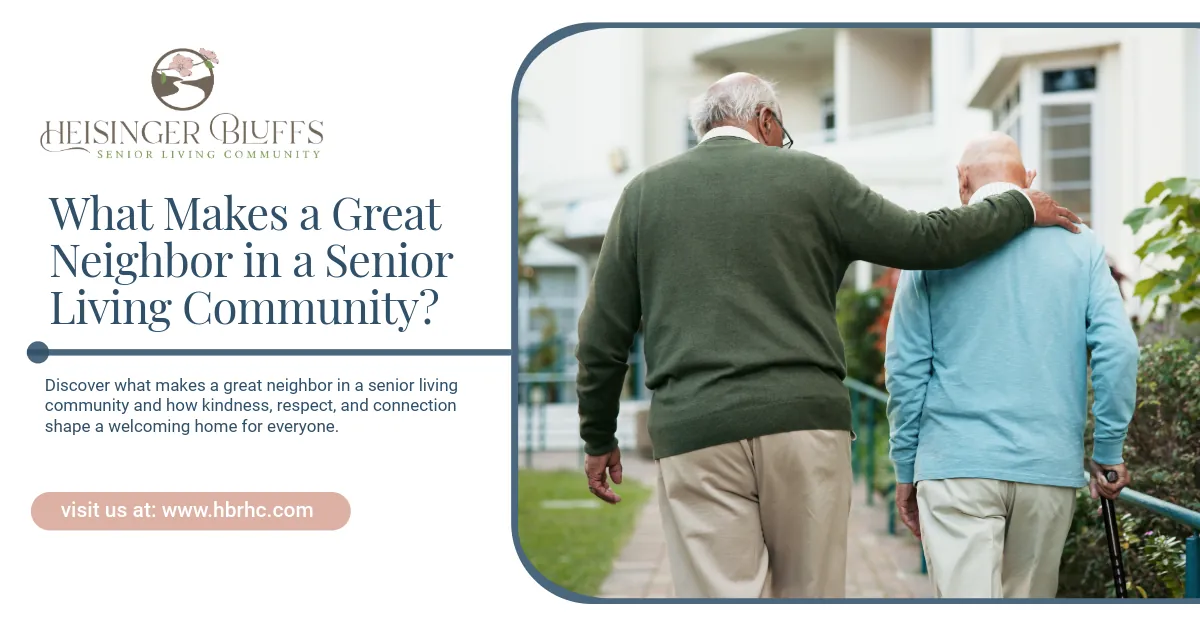
Perhaps the clearest sign of a great neighbor is how they respond when things get hard. Illness, hospital stays, the loss of a spouse, or a decline in mobility are realities that many residents will face at some point. A great neighbor does not disappear during these moments. They show up.
That might look like checking in regularly during a hospital stay, saving a spot at a favorite table, bringing back a plate from an event someone missed, or simply sitting with a grieving neighbor without needing to fill the silence with words. These moments of quiet support are often remembered far longer than any lighthearted conversation from an ordinary day.
Communities that cultivate this kind of neighborliness tend to see a ripple effect. When residents witness their neighbors being cared for during hard times, they feel more confident that they, too, will be supported when their own turn comes. That sense of security is part of what makes a place feel like home rather than simply a place to live.
At a Glance: Everyday Qualities of a Great Neighbor
| Quality | What It Looks Like in Daily Life |
|---|---|
| Respect for privacy | Knocking before entering, respecting quiet hours, not assuming every open door is an invitation |
| Everyday kindness | Small courtesies like holding doors, remembering preferences, offering patience on hard days |
| Balanced involvement | Joining activities and welcoming others without dominating conversations or events |
| Clear communication | Addressing small issues directly, apologizing sincerely, avoiding lingering resentment |
| Openness to differences | Welcoming new residents and people with different backgrounds or personalities |
| Consistent presence | Checking in during illness, grief, or transitions, not just during easy, social moments |
How Communities Help Cultivate Good Neighbors
While individual character matters most, the design and programming of a senior living community can make it easier for neighborly habits to take root. Shared dining rooms encourage casual daily conversation. Common courtyards and lounges give residents low-pressure spaces to gather without needing to plan a formal outing. Regularly scheduled activities, from fitness classes to game nights to seasonal events, create repeated touchpoints where friendships can form naturally over time.
Staff and community leadership also play a quiet but important role. Thoughtful move-in processes that introduce new residents to a few familiar faces, mentorship pairings between longtime residents and newcomers, and staff who model warmth and patience all help set the tone for how neighbors treat one another.
A community that actively encourages inclusion, rather than simply hoping it happens on its own, tends to see stronger, more consistent neighborly behavior across its resident population.
Ultimately, being a great neighbor is a skill that can be encouraged, modeled, and supported, not just an inborn personality trait. Communities that take this seriously, through thoughtful programming, welcoming traditions, and a culture that values kindness, tend to become places where residents genuinely look forward to seeing one another each day.
Final Thoughts
Being a great neighbor in a senior living community comes down to a set of habits anyone can practice: respecting privacy, offering everyday kindness, staying involved without overstepping, communicating honestly, welcoming differences, and showing up during hard times. When enough residents live by these values, a building full of individual apartments becomes something much more meaningful, a true community.
At Heisinger Bluffs, we see these qualities in action every day among the residents who call our community home, and we work hard to create the kind of environment, through thoughtful programming, welcoming traditions, and attentive staff, where those relationships can naturally take root.
If you are exploring senior living options for yourself or a loved one in Jefferson City, Missouri, we would love to show you around and introduce you to the neighbors who make our community special. Contact us today to schedule a visit and see what makes Heisinger Bluffs feel like home.
Frequently Asked Questions
What if a new resident is shy and struggles to make friends right away?
This is common, and it usually improves with time and gentle encouragement. Attending smaller, low-pressure activities first, sitting with the same familiar faces at meals, and letting staff make a few personal introductions can help a quieter resident ease into community life without feeling overwhelmed.
How should residents handle a disagreement with a neighbor?
The healthiest approach is usually a calm, direct conversation as soon as possible, rather than letting frustration build. If a conversation does not resolve things, involving a staff member or community coordinator can help mediate the issue before it affects the broader sense of community.
Do great neighbors need to be highly social or extroverted?
Not at all. Being a great neighbor is about kindness, respect, and consistency, not personality type. Quieter residents can be wonderful neighbors through one-on-one check-ins, thoughtful gestures, and genuine listening, even if they are not the ones organizing group events.
How can family members support their loved one in becoming a good neighbor?
Encouraging participation in community activities, checking in about how new friendships are developing, and reinforcing the value of community life during visits can all help. Family members can also model that same warmth when visiting, since staff and other residents often notice and appreciate it.
What role does staff play in fostering good neighbor relationships?
Staff often set the tone for the entire community. Thoughtful introductions for new residents, consistent encouragement of inclusive behavior, and quick, fair support during conflicts all help create an environment where positive neighbor relationships can flourish.
Sources:
- https://psychology.town/environmental/enhancing-residential-life-community-engagement/
- https://entyresolutions.com/blog/the-importance-of-community-engagement-enhancing-resident-satisfaction
- https://www.agingcare.com/questions/what-options-do-we-have-to-caring-for-an-elderly-neighbor-497964.htm
- https://www.quora.com/What-are-good-ways-to-help-elderly-neighbors-without-being-intrusive
- https://ilbrainhealth.org/2025/09/28/good-neighbor-day-how-you-can-help-an-aging-neighbor/