
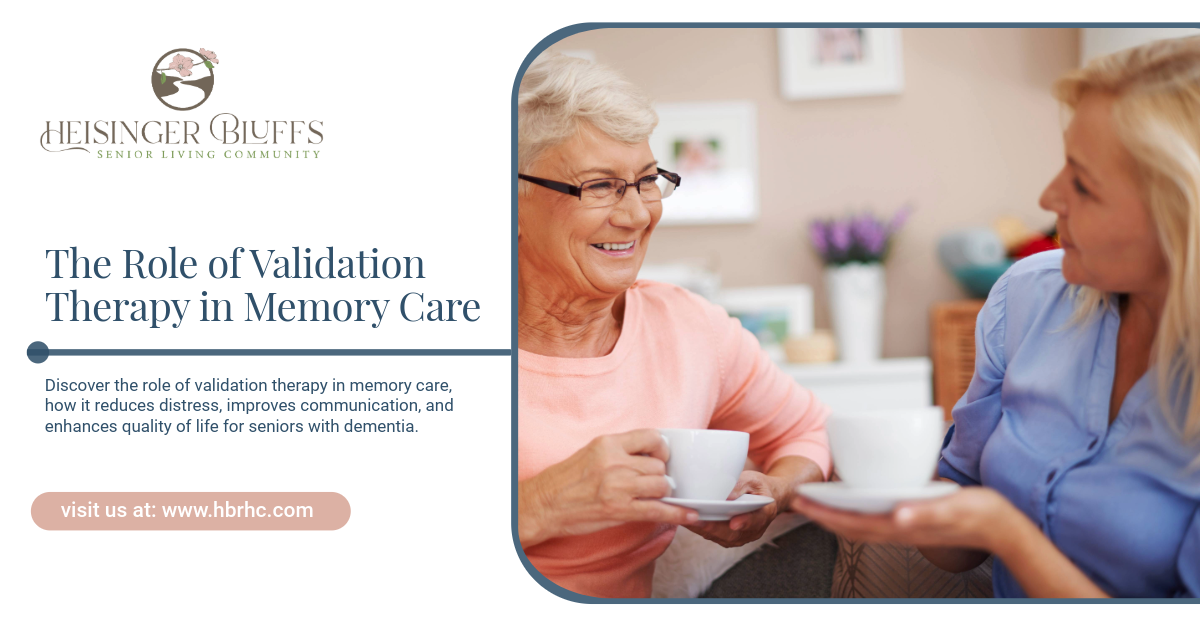
The Role of Validation Therapy in Memory Care
Key Highlights
- Validation therapy helps individuals with dementia feel heard, understood, and respected
- It focuses on emotions rather than correcting facts or memories
- This approach can reduce agitation, anxiety, and behavioral challenges
- Caregivers build stronger connections by entering the person’s reality
- Validation therapy is widely used in modern memory care settings
- Real-world applications show improved emotional well-being and cooperation
Caring for someone with dementia requires more than managing physical needs—it demands empathy, patience, and a deep understanding of how cognitive changes affect perception and emotions. One of the most effective and compassionate approaches used in memory care today is validation therapy.
Rather than correcting or confronting individuals when they express confusion or false memories, validation therapy focuses on acknowledging their feelings and experiences. This simple yet powerful shift in communication can dramatically improve emotional well-being, reduce distress, and strengthen relationships between caregivers and residents.
What Is Validation Therapy?
Validation therapy is a communication technique developed in the 1960s by social worker Naomi Feil. It is designed specifically for individuals with dementia or cognitive impairment.
At its core, validation therapy involves:
- Accepting the person’s reality
- Acknowledging their emotions
- Responding with empathy rather than correction
Instead of saying, “That’s not true,” caregivers might respond with, “That sounds important to you—tell me more.”
Why Validation Therapy Matters in Memory Care
As dementia progresses, individuals may:
- Misremember events
- Confuse past and present
- Experience heightened emotions
- Struggle with communication
Correcting these inaccuracies can often lead to:
- Frustration
- Anxiety
- Agitation
- Loss of trust
Validation therapy avoids these negative outcomes by focusing on emotional truth rather than factual accuracy.
Emotional Needs Over Facts
For individuals with dementia, emotions often remain intact even as memory declines. Validation therapy recognizes that:
- Feelings are real, even if memories are not accurate
- Emotional reassurance is more important than factual correction
Real Example from Practice: In caregiving settings, we’ve seen residents repeatedly ask to “go home,” even when they are already in a safe environment. Instead of correcting them, caregivers using validation therapy respond with:
- “What do you miss most about home?”
- “Tell me about your favorite room.”
This approach often leads to calming conversations rather than distress.
Key Principles of Validation Therapy
1. Accept the Person’s Reality
Rather than forcing someone into our reality, we step into theirs.
2. Acknowledge Emotions
Recognizing feelings helps individuals feel heard and respected.
3. Use Empathetic Communication
Tone, body language, and facial expressions are just as important as words.
4. Avoid Confrontation
Correcting or arguing can escalate behaviors.
5. Build Trust and Connection
Consistent validation strengthens relationships over time.
Benefits of Validation Therapy
1. Reduces Agitation and Anxiety
Validation therapy helps de-escalate emotional distress by:
- Providing reassurance
- Reducing confusion
- Creating a sense of safety
Real Example: We’ve seen individuals who were previously resistant to care become more cooperative after caregivers began validating their feelings instead of correcting them.
2. Improves Communication
As verbal skills decline, communication becomes more emotional than factual.
Validation therapy:
- Encourages conversation
- Supports nonverbal communication
- Helps caregivers interpret underlying needs
3. Enhances Emotional Well-Being
Feeling understood can:
- Reduce loneliness
- Improve mood
- Increase engagement
4. Strengthens Caregiver-Resident Relationships
Trust is critical in memory care. Validation therapy builds trust by:
- Showing respect
- Demonstrating empathy
- Creating meaningful interactions
5. Reduces Behavioral Challenges
Many behaviors in dementia are expressions of unmet needs. Validation therapy helps identify:
- Fear
- Loneliness
- Frustration
Addressing these emotions often reduces behaviors like:
- Wandering
- Aggression
- Repetition
Validation Therapy vs. Reality Orientation
| Approach | Focus | Outcome |
|---|---|---|
| Validation Therapy | Emotions and personal reality | Reduces distress, builds trust |
| Reality Orientation | Facts and correction | Can increase frustration in later stages |
Both approaches have their place, but validation therapy is often more effective in moderate to advanced stages of dementia.
How Validation Therapy Works in Practice
Scenario 1: Repetitive Questions
- Situation: A resident repeatedly asks, “When is my mother coming?”
- Validation Response: “You’re thinking about your mother—what was she like?”
Scenario 2: Delusions or Misperceptions
- Situation: A resident believes someone stole their belongings.
- Validation Response: “That must feel upsetting. Let’s see how we can help you feel more comfortable.”
Scenario 3: Desire to “Go Home”
- Situation: A resident wants to leave to go home.
- Validation Response: “Home sounds really important to you. What do you miss most about it?”
Case Study: Reducing Agitation Through Validation
Background
A resident in a memory care setting frequently became agitated in the evenings, insisting on leaving to “pick up her children.”
Intervention
Caregivers began using validation therapy by:
- Acknowledging her concern
- Asking about her children
- Engaging her in conversation about her role as a parent
Outcome
- Agitation decreased significantly
- Emotional distress was reduced
- The resident became more cooperative
This aligns with research suggesting that person-centered communication approaches improve behavioral outcomes in dementia care.
Techniques Used in Validation Therapy
1. Reflective Listening
Repeat or rephrase what the individual says to show understanding.
2. Open-Ended Questions
Encourage conversation rather than yes/no responses.
3. Empathy Statements
Examples:
- “That sounds difficult.”
- “I can see why you feel that way.”
4. Nonverbal Communication
- Maintain eye contact
- Use gentle touch (when appropriate)
- Keep a calm tone
Common Mistakes to Avoid
- Correcting the person: “That’s not true.”
- Arguing or reasoning: Logic may not be effective
- Dismissing feelings: “Don’t worry about it.”
- Ignoring emotional cues: Behavior often signals deeper needs
When to Use Validation Therapy
Validation therapy is especially helpful during:
- Moments of confusion
- Emotional distress
- Behavioral challenges
- Repetitive questioning
It is most effective in middle to late stages of dementia, when reality orientation becomes less effective.
Integrating Validation Therapy into Daily Care
For Families
- Practice patience and empathy
- Focus on connection rather than correction
- Use validation during difficult moments
For Caregivers
- Incorporate validation into daily routines
- Use it during personal care tasks
- Build it into communication training
Real Example: In caregiving environments, we’ve seen that even small shifts, like changing tone and wording, can transform interactions from stressful to calming.
The Science Behind Validation Therapy
Validation therapy is rooted in:
- Person-centered care principles
- Psychological theories of aging
- Emotional memory preservation
Research indicates that emotional memory often remains intact longer than factual memory, which explains why validation therapy is effective.
Why Validation Therapy Is Essential in Modern Memory Care
Today’s memory care communities are moving toward holistic, person-centered approaches. Validation therapy fits into this model by:
- Respecting individuality
- Prioritizing emotional well-being
- Reducing reliance on medication
It is increasingly recognized as a best practice in dementia care.
Final Thoughts
Validation therapy is more than a communication technique—it’s a philosophy of care that prioritizes dignity, empathy, and understanding.
By meeting individuals where they are, caregivers can create meaningful connections, reduce distress, and improve overall quality of life.
At Heisinger Bluffs, we incorporate validation therapy into daily memory care practices, recognizing that every interaction is an opportunity to provide comfort, build trust, and support emotional well-being in residents living with dementia. Reach out today!
Frequently Asked Questions
What is validation therapy in memory care?
Validation therapy is a communication approach that focuses on acknowledging and validating the emotions of individuals with dementia rather than correcting their statements.
Does validation therapy really work?
Yes. It has been shown to reduce agitation, improve communication, and enhance emotional well-being in individuals with dementia.
When should validation therapy be used?
It is most effective during moments of confusion, distress, or behavioral challenges, especially in moderate to advanced stages of dementia.
Is validation therapy better than reality orientation?
It depends on the stage of dementia. Validation therapy is generally more effective in later stages, while reality orientation may work in early stages.
Can families use validation therapy at home?
Absolutely. With practice, family members can use validation techniques to improve communication and reduce stress during caregiving.
Sources:
- https://vfvalidation.org/
- https://www.hands-ondementia.com/post/naomi-feil-founder-of-the-validation-method
- https://www.alz.org/help-support/caregiving/stages-behaviors/memory-loss-confusion
- https://www.alzheimers.org.uk/about-dementia/managing-the-risk-of-dementia/reduce-your-risk-of-dementia/social-isolation
- https://www.cottagelitchfield.com/blog/how-to-handle-wandering-in-dementia-patients



Share This Article
You May Also Like To Read