
Key Highlights
- The most valuable amenities are the ones used every single day, and dining sits at the top of that list by a wide margin.
- Transportation is the amenity that most directly determines whether a resident keeps their independence or gradually loses it.
- On-site therapy and health services reduce the disruption of medical appointments and catch decline earlier than off-site care.
- Impressive features like theaters, pools, and grand lobbies photograph well but see far less use than families expect.
- Every amenity is only as good as the staffing behind it, which makes staff turnover a more useful question than any feature list.
- This article explains how to rank amenities by real-world impact, what to ask on a tour, and how to match features to the specific person moving in.
Every senior living brochure looks roughly the same. Sunlit dining room, a couple laughing over coffee, a fitness class, a landscaped courtyard. The photographs are accurate, and they are also not particularly useful, because they show what a community has rather than what a resident's Tuesday actually looks like.
Families touring for the first time tend to be impressed by the wrong things. The theater room gets a reaction. The chandelier in the lobby gets a reaction. Meanwhile, the questions that will determine whether someone thrives or declines over the next three years go unasked, because they concern things that are difficult to photograph.
This article sorts senior living amenities by how much they actually affect daily life. The framework is simple: how often will this be used, and what happens to the resident's independence and wellbeing if it is done poorly.
The Amenities That Shape Every Day
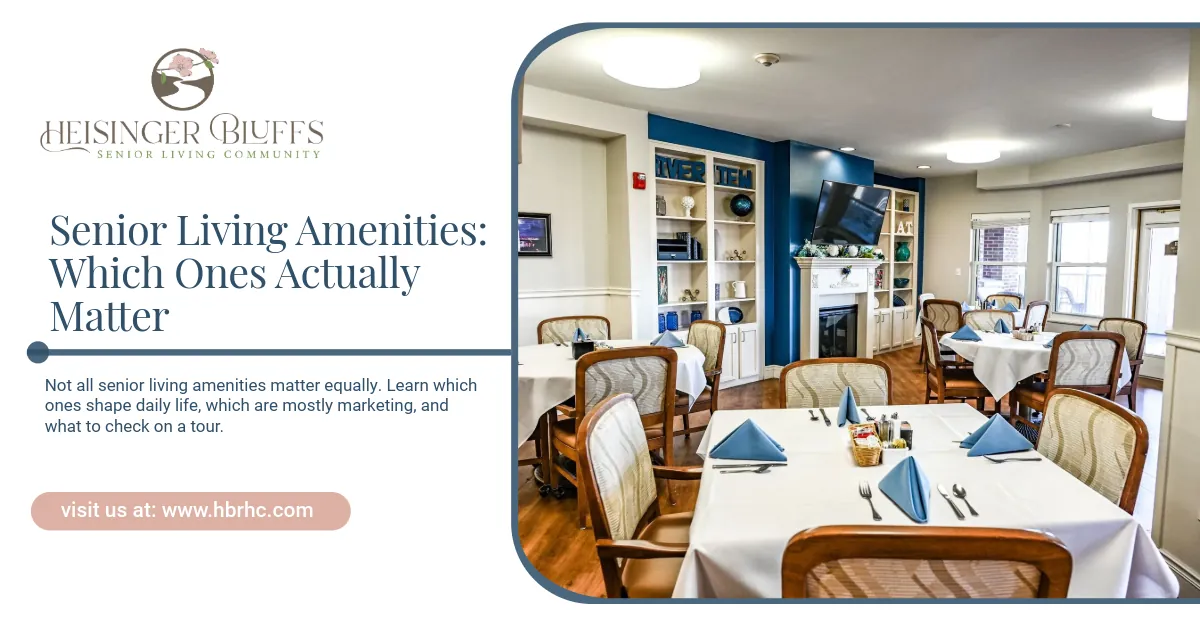
Dining
This is the amenity that matters most, and it is not close.
A resident interacts with dining three times a day, every day. Over a year, that is roughly a thousand encounters with the same service. No other feature comes near that frequency, and few have comparable consequences. Poor nutrition in older adults contributes to muscle loss, weakened immune function, slower healing, and increased fall risk. Meals are also the primary social structure of the day, which means dining quality drives engagement as much as it drives nutrition.
What separates good dining from adequate dining:
- Flexible hours rather than a single seating. Older adults have varied schedules and appetites. Communities that require everyone to eat at 5:15 produce residents who skip meals.
- Genuine choice at every meal. A daily alternative menu, not just the entree of the day. Food preferences do not disappear with age.
- Accommodation of therapeutic diets without segregating people. Diabetic, low sodium, renal, and modified texture diets should be prepared with the same care as everything else. Ask specifically how texture-modified meals are presented, because the difference between thoughtful preparation and a beige scoop is enormous for dignity and intake.
- A registered dietitian involved in menu planning. Not a vendor spreadsheet.
- Someone tracking who is not eating. This is the quiet indicator of a strong dining program. Staff who notice that a resident has skipped four consecutive lunches and follow up are catching problems weeks earlier than anyone else would.
Do not take the tour lunch as representative. Ask to eat on an ordinary weekday, unannounced if possible, and ask a resident at the next table what they think.
Transportation
Transportation is the most underrated amenity in senior living and arguably the one most tied to preserved independence.
Driving cessation is one of the harder transitions of later life, and it typically triggers a cascade. Appointments get missed, errands stop happening, social contact narrows to whoever visits, and the person's world contracts to the building they live in. A strong transportation program interrupts that entire sequence.
The questions worth asking are specific:
Is transportation limited to medical appointments, or does it also cover shopping, religious services, banking, and social outings? How far does it travel, and does that radius include the specialists the person already sees? How much advance notice is required? What happens when an appointment runs long, and the scheduled pickup has passed? Is there a fee per trip, and is it included or billed separately? Is the vehicle wheelchair accessible?
A community with a van that runs medical appointments twice a week within a five-mile radius offers something very different from one with daily scheduled routes and flexible booking, even though both list transportation on the brochure.
On-Site Health and Therapy Services
The value here is friction reduction. Every off-site appointment requires coordination, transportation, waiting, and recovery time, and each step is a place where care gets skipped.
Look for on-site physical, occupational, and speech therapy, since these are the services most frequently needed and the ones where consistency matters most. Ask whether therapy is provided by an in-house team or a contracted agency, how quickly a resident can be evaluated after a change in condition, and whether therapy can be initiated without leaving the building.
Also worth asking: whether visiting physicians, podiatrists, dentists, or optometrists come on site, whether there is a nurse available and during which hours, and how medication management is handled.
On-site clinical presence has a second benefit families rarely consider. Staff who see a resident daily notice changes that a physician seeing them twice a year cannot. Early detection of decline is itself a form of care.
Housekeeping, Laundry, and Maintenance
These are the amenities that quietly removed the reason many people moved in the first place.
The tasks that become genuinely difficult with age are not the enjoyable ones. They are the bathtub, the vacuum, the laundry basket carried down stairs, the burned-out bulb in the high fixture, the gutters. Reliable service in these areas returns hours and energy to the resident and eliminates the safety risks that come with attempting them.
Ask about frequency, what is included versus billed separately, how maintenance requests are submitted, and typical response time.
Social and Recreational Programming
Every community has an activity calendar. The calendar is not the amenity. Participation is the amenity.
Ask for a copy of last month's calendar rather than a sample, then ask how many residents typically attend a given event. A calendar with twelve activities a day that nobody goes to is worse than one with three that fill the room.
Look for variety of type, not just quantity. Physical activities, cognitive activities, creative activities, spiritual services, intergenerational contact, and outings into the surrounding community. Look also for resident input into programming, since activities designed for residents perform worse than activities designed with them.
Social engagement is not a soft benefit. Isolation in older adults is associated with increased risk of depression, cognitive decline, and poorer physical health outcomes, which makes programming a health intervention rather than entertainment.
Amenities That Matter More Than They Appear
- Outdoor access. Walkable paths, seating in shade, raised garden beds, and doors residents can actually use without asking permission. Time outdoors supports sleep quality, vitamin D, and mood. Check whether the courtyard is accessible from resident areas or requires crossing the entire building.
- Small gathering spaces. Grand lobbies impress visitors and are used by almost no one. The spaces that generate real social life are small: a library nook, a card table by a window, a coffee station where four people can sit. Count these rather than measuring the atrium.
- Family-friendly spaces. A private dining room families can reserve, comfortable areas for visits with grandchildren, and guest accommodations for out-of-town relatives. These directly affect visit frequency, and visit frequency affects everything else.
- Pet policy. For a resident with a pet, this is not a minor feature. Ask about size limits, fees, and what happens if the resident becomes unable to care for the animal.
- Reliable Wi-Fi and technology support. Video calls with distant family, telehealth appointments, streaming, and audiobooks. Ask whether someone on staff actually helps residents with devices, because coverage without support is not much use.
Amenities That Get Oversold
None of these are bad. They are simply weighted more heavily by touring families than by the residents who live there.
- Theater rooms are used occasionally, often for group movie afternoons that could happen in any large room.
- Swimming pools generate excitement on tours and modest ongoing use. Before assigning weight to a pool, ask honestly whether the person has swum in the last five years, and ask the community how many residents use it weekly.
- Extensive fitness equipment matters far less than whether classes are offered at appropriate levels with an instructor trained in older adult exercise. Equipment without programming sits idle.
- Elaborate common area decor tells you about the marketing budget. It does not tell you about staffing ratios, food quality, or turnover.
Weighing Amenities by Actual Use
| Amenity | Typical Frequency of Use | The Question That Reveals Quality |
|---|---|---|
| Dining | Three times daily | May I eat an ordinary weekday meal, unannounced? |
| Housekeeping and laundry | Weekly, ongoing | What exactly is included, and what is billed extra? |
| Social programming | Daily if it fits the person | How many residents attended this event last month? |
| Transportation | Several times weekly | What destinations beyond medical appointments are covered? |
| On-site therapy | Episodic but high impact | How fast can a resident be evaluated after a change? |
| Outdoor space | Daily in good weather | Can residents access it independently? |
| Fitness programming | Two to five times weekly | Who leads classes, and what is their training? |
| Theater or pool | Occasional | How many residents use this in a typical week? |
The Factor Underneath Every Amenity
An amenity is a promise that staff have to keep. That makes staffing the question that determines whether any of the features on a brochure translate into daily reality.
Ask about staff turnover in the past year. Ask how long the dining director, activities director, and nursing leadership have been in their roles. Ask about staffing levels on evenings and weekends, which is when families rarely tour and when service gaps are most visible.
Consistency of assignment matters too. Residents cared for by the same small group of staff receive better care, because those staff notice changes. A community where a different aide appears each shift cannot deliver that regardless of how good the building looks.
We toured a family through a community several years ago that had everything on their list, including a theater and a beautifully appointed lobby. The daughter was ready to sign. Her father asked one question at the end of the tour, which was how long the woman serving coffee had worked there. The answer was eleven years, and she knew every resident's name and how they took it. He said that told him more than the rest of the tour combined.
In our experience, he was right, and the length of tenure among frontline staff remains one of the more reliable signals a family can pick up in an hour.
Match the Amenities to the Person
The best amenity package is the one suited to the individual, not the highest-scoring one in the abstract.
- Consider temperament. A private person will not be improved by a community organized around constant group activity. What they may need is a quiet library, a walking path, and the option to dine at a small table rather than a communal one.
- Consider mobility. Someone using a walker needs to know the distance from apartment to dining room, whether seating exists along the way, and how the corridors handle a wheelchair. A large campus can be an asset or a daily obstacle depending on the person.
- Consider existing interests. A lifelong gardener needs raised beds more than a fitness center. A musician needs a piano. Ask directly what the person wants to keep doing.
- Consider the next five years. Needs change. A community offering multiple levels of care means a future transition may not require another move, which preserves relationships with staff and neighbors at exactly the moment stability matters most.
Choosing With Clarity
The features that look most impressive on a tour are rarely the ones that shape a resident's daily experience. Dining, transportation, on-site health services, dependable housekeeping, and programming that people genuinely attend do far more for quality of life than any showpiece, and all of them rest on the quality and consistency of the staff delivering them. Knowing which questions to ask turns a pleasant tour into a real evaluation.
At Heisinger Bluffs, we welcome those questions. Our community offers restaurant-style dining with dietitian-guided menus, scheduled transportation, on-site physical, occupational, and speech therapy, housekeeping and maintenance services, and a full activity program shaped by resident input, along with multiple levels of care including assisted living, long-term care, and memory care so that a change in needs does not have to mean another move. We would rather have you eat a regular Tuesday lunch with us and talk to our residents than walk through a polished presentation. We are proud to serve older adults and their families throughout Jefferson City, Missouri, and the surrounding communities.
If you are comparing communities and want honest answers about what daily life actually looks like, contact us today to schedule a tour!
Frequently Asked Questions
Which amenity should we prioritize if we can only prioritize one?
Dining. It is used most often, has the clearest health consequences, and tends to correlate with overall operational quality. A community that executes food service well is usually managing other things well too.
Are amenities included in the monthly fee or billed separately?
It varies considerably, and this is worth clarifying in writing. Housekeeping, basic transportation, and activities are commonly included. Salon services, guest meals, additional transportation, and certain therapies are frequently extra. Ask for a written list of what is included and what carries a fee.
How can we tell if the activity calendar reflects reality?
Visit unannounced during a scheduled activity and see who is there. Ask residents directly what they did yesterday. Ask staff which activities fill up and which get canceled for low turnout. Communities comfortable answering that honestly usually have something to be comfortable about.
Does a larger community mean better amenities?
Larger communities often offer more features and more programming variety. Smaller communities often offer more staff familiarity and shorter distances. Neither is inherently better, and the right answer depends on whether the person values variety or intimacy.
What if our loved one says they will not use any of it?
Common, and often temporary. Participation frequently increases after the adjustment period, particularly when staff make individual invitations rather than posting a schedule. Ask how the community handles new residents who are reluctant, because a thoughtful answer to that question tells you a great deal.
Sources:
- https://pmc.ncbi.nlm.nih.gov/articles/PMC8399049/
- https://www.usaging.org/socialengagement
- https://www.aplaceformom.com/caregiver-resources/articles/choosing-the-right-assisted-living-facility
- https://health.usnews.com/senior-care/articles/steps-for-choosing-the-right-senior-living-facility