
Key Highlights
- Falls, social isolation, missed medications, and delayed emergency response are among the most common everyday risks older adults face living alone.
- Community living reduces fall risk through home design, from step-free layouts to grab bars, and through staff who notice problems early.
- Built-in social contact at meals and activities directly addresses isolation, which research consistently links to declining physical and cognitive health.
- On-site wellness staff and routine check-ins catch small health changes and medication issues before they become serious problems.
- Emergency response times shrink significantly when help is down the hall instead of a phone call and a drive away.
- A side-by-side look at risks shows how many everyday hazards of living alone are directly addressed by the structure of community living.
Most older adults want to stay independent for as long as possible, and that instinct makes sense. What often goes unexamined is how much everyday risk comes bundled with living entirely alone, risks that tend to build quietly over months and years rather than announcing themselves all at once. A loose rug becomes a fall. A skipped afternoon meal becomes a pattern of poor nutrition. A missed dose becomes a hospital visit. These changes rarely happen overnight, which is exactly why they are so easy to miss, both for the older adult experiencing them and for family members who only see snapshots during occasional visits.
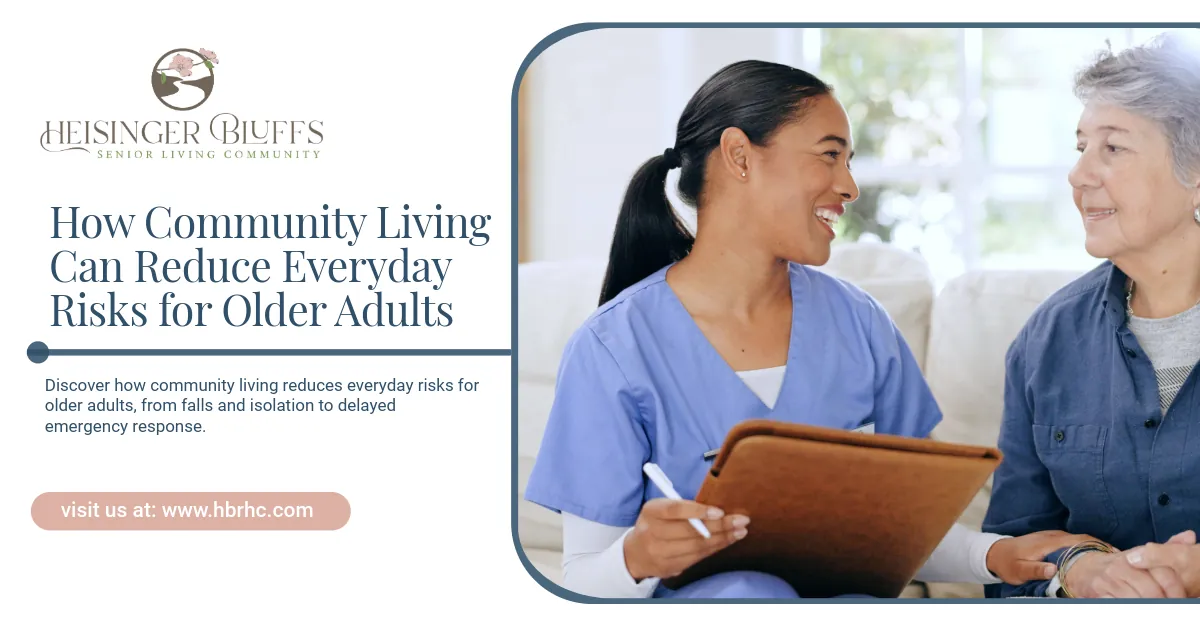
Community living does not eliminate the realities of aging, but it does directly reduce many of the everyday risks that come with managing a home and a health condition entirely alone. This article looks at the specific risks older adults commonly face living independently, why those risks tend to go unnoticed until they become serious, and how the structure of community living addresses each one.
The Everyday Risks of Living Alone
Before looking at solutions, it helps to name what these risks actually are, because many of them are easy to underestimate until they become a crisis.
- Falls. A fall is one of the most common and most serious risks older adults face at home. Loose rugs, poor lighting, stairs, and slippery bathroom floors create hazards that are easy to overlook in a home a person has lived in for decades, precisely because they are so familiar.
- Social isolation. Living alone, especially after a spouse passes away or friends move or become less mobile, can lead to days or even weeks with minimal social contact. Isolation is not just an emotional issue. It is consistently linked to measurable declines in both physical and cognitive health.
- Medication mismanagement. Managing multiple prescriptions, correct dosages, timing, and refills becomes harder with age, memory changes, or vision difficulties. A missed or doubled dose can have serious consequences, and without anyone checking in, these errors can go unnoticed.
- Delayed emergency response. When a fall, chest pain, or sudden illness happens at home alone, the time between the event and getting help can be dangerously long, especially if the person cannot reach a phone.
- Nutritional decline. Cooking for one, especially with reduced mobility or energy, often leads to skipped meals or reliance on less nutritious convenience foods, which can quietly undermine overall health over time.
- Home maintenance hazards. Tasks like changing smoke detector batteries, clearing gutters, or fixing a loose stair railing become harder to manage alone, and neglected maintenance can turn into safety hazards.
Why These Risks Are Easy to Miss From the Outside
Part of what makes these risks dangerous is how invisible they are to people who do not live with them every day. A weekly phone call or a monthly visit from an adult child often catches only a snapshot: a parent who sounds tired one week and fine the next, without revealing the pattern underneath. Older adults themselves frequently underreport these issues too, sometimes out of genuine pride in their independence, and sometimes because gradual decline simply becomes the new normal before anyone, including the person experiencing it, recognizes how much has changed.
This is often described as a slow accumulation rather than a single turning point. A person does not typically go from fully safe to at risk overnight. Instead, small adjustments pile up over time: skipping the stairs to the basement because they feel unsteady, letting a prescription refill slide by a few days, eating cereal for dinner because cooking feels like too much effort. None of these individually seems alarming, but together they represent a meaningful erosion of safety and wellbeing that can be difficult for family members to see until a crisis forces the issue into the open.
How Community Living Reduces Fall Risk
Fall prevention is one of the clearest areas where community living makes a measurable difference. Senior living communities are typically designed with fall risk in mind from the ground up, with features like step-free entrances, wide hallways, grab bars in bathrooms, non-slip flooring, and consistent, bright lighting throughout common areas. These design choices remove many of the hazards that accumulate gradually in a private home over years.
Beyond the physical environment, staff presence matters just as much as design. In a private home, a fall might go unnoticed for hours. In a community setting, staff conduct regular rounds, and residents are surrounded by neighbors and team members who tend to notice quickly if something seems off, whether that is a missed meal, an unanswered knock, or a change in gait that suggests a new mobility concern developing before it leads to a fall.
How Community Living Reduces Social Isolation
Isolation is often the quietest risk on this list, but it is far from the least serious. Community living structurally addresses isolation simply by design: shared dining rooms, scheduled activities, common areas, and daily interaction with neighbors and staff create built-in opportunities for connection that do not require a person to plan or arrange them alone.
This matters because isolation tends to compound other risks. A person who eats most meals alone is more likely to skip them. A person who rarely leaves their home is less likely to notice, or be noticed for, gradual changes in health or mobility. Regular social contact, even something as simple as a daily meal with familiar faces, provides both genuine companionship and an informal layer of observation that catches problems early.
How Community Living Improves Health and Medication Management
Many communities offer wellness check-ins, medication management support, and on-site or visiting nursing staff who can catch small issues before they escalate. This kind of oversight is difficult to replicate at home without hiring dedicated help, and even then, it typically covers only a few hours a day rather than the more continuous presence available in a community setting.
Routine check-ins also make it easier to track patterns over time. A staff member who sees a resident daily is more likely to notice a gradual weight change, a new tremor, or increasing confusion than a family member who visits weekly or a physician seen every few months. This kind of early detection often makes the difference between a manageable adjustment and a medical emergency.
How Community Living Speeds Emergency Response
When something goes wrong, the amount of time before help arrives matters enormously. At home, a person living alone may need to reach a phone, dial for help, and wait for emergency responders to arrive, a process that can take significant time even under the best circumstances. In a community setting, emergency call systems, staff who are present around the clock, and neighbors nearby all shorten that window considerably.
In our experience, we've seen how much this difference matters in practice. One resident who lived independently on our campus missed her usual morning coffee in the dining room, which prompted a staff member to check in within the hour. She had fallen in her apartment overnight and was unable to reach her phone. Because staff noticed her absence from a routine she rarely missed, she received help far sooner than she would have if she had still been living alone in her previous home, where the nearest neighbor was a considerable distance away and had no reason to check on her that day.
Addressing Nutrition and Home Maintenance Risks
Two risks that receive less attention than falls or isolation, but matter just as much, are poor nutrition and neglected home maintenance. Cooking for one is simply harder to sustain than cooking for a household, and the motivation to prepare a full, balanced meal tends to fade when there is no one else at the table. Over months, this can lead to noticeable weight loss, nutrient deficiencies, and reduced energy, all of which make every other risk on this list more likely. Community living addresses this directly by providing regular meals in a shared dining setting, which removes both the burden of meal preparation and the isolation of eating alone.
Home maintenance follows a similar pattern. A homeowner living alone has to notice, plan for, and either complete or hire out every repair, from a leaky faucet to a malfunctioning smoke detector. When mobility or energy is limited, these tasks are often deferred indefinitely, and a deferred repair can quietly become a safety hazard, a loose railing that eventually gives way, or a smoke detector with a dead battery that goes unnoticed for months. In a community setting, maintenance is handled as part of daily operations, removing this burden entirely and ensuring that small issues get addressed before they become genuine hazards.
Comparing Everyday Risks: Living Alone vs. Community Living
| Risk Category | Living Alone | Community Living |
|---|---|---|
| Falls | Hazards often go unaddressed for years; help may not arrive quickly | Homes designed to reduce hazards; staff notice issues quickly |
| Social isolation | Contact depends entirely on the individual reaching out | Built-in daily interaction through meals and activities |
| Medication management | Easy to lose track without daily oversight | Routine check-ins and support catch issues early |
| Emergency response | Can be delayed significantly, especially overnight | Call systems and on-site staff shorten response time |
| Nutrition | Cooking for one often leads to skipped or poor meals | Regular, balanced meals provided in a social setting |
| Home maintenance | Falls on the individual, often delayed or neglected | Handled by community staff as part of daily operations |
Reducing Risk Without Sacrificing Independence
The goal of community living is not to take independence away. It is to remove the everyday hazards that quietly build up when someone manages a home, health, and daily life entirely alone, while preserving the ability to live on one's own terms. Falls, isolation, medication mistakes, and delayed emergency response are not inevitable parts of aging. They are risks that thoughtful design, consistent staff presence, and built-in social connection can meaningfully reduce.
At Heisinger Bluffs, our community is designed around exactly this kind of everyday safety, from fall-conscious layouts and attentive staff to daily social opportunities and responsive emergency support. We proudly serve older adults and families throughout Jefferson City, Missouri, and the surrounding area. If you or a loved one is weighing the risks of living alone against the benefits of community living, contact us today to see how our team can help.
Frequently Asked Questions
Does moving to a senior living community actually reduce fall risk?
Yes. Communities are typically designed with fall prevention in mind, including step-free layouts, grab bars, and consistent lighting, and staff presence means falls are noticed and responded to far more quickly than they might be at home.
Is loneliness really a health risk, or just an emotional issue?
Both. Social isolation is consistently linked to measurable declines in physical and cognitive health over time, not just to feelings of unhappiness. Regular social contact is one of the most effective ways to reduce that risk.
How quickly does staff typically respond in an emergency?
Response times vary by community, but the presence of on-site staff around the clock, combined with emergency call systems, generally allows for much faster response than a person living alone waiting to reach a phone and call for help themselves.
Is community living safer than hiring in-home help?
In-home help can reduce some risks, but coverage is often limited to a few hours a day. Community living provides more continuous oversight, along with the added benefit of built-in social contact and a home environment already designed with safety in mind.
Do I have to give up independence to reduce these risks?
No. Most communities are designed to support independence while reducing the risks that come with managing a home and health entirely alone. Residents still make their own daily choices, but with a safety net and social structure in place.
Sources:
- https://www.cdc.gov/falls/about/index.html
- https://www.mayoclinic.org/healthy-lifestyle/healthy-aging/in-depth/fall-prevention/art-20047358
- https://www.nia.nih.gov/health/loneliness-and-social-isolation/loneliness-and-social-isolation-tips-staying-connected
- https://pmc.ncbi.nlm.nih.gov/articles/PMC8399049/