
Key Highlights
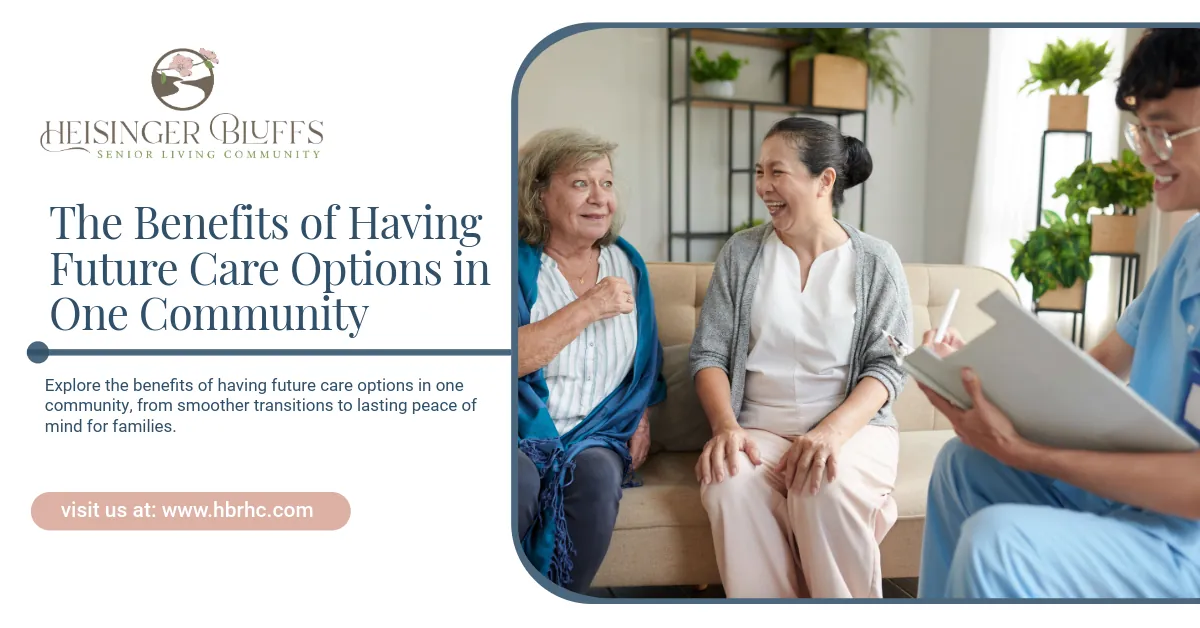
- Communities that offer multiple levels of care on one campus allow residents to age in place without relocating as their needs change.
- Moving to a new community later in life, often during a health crisis, adds stress that can be avoided with future care options already in place.
- Staying within one community preserves relationships with familiar staff, neighbors, and surroundings even if a higher level of care becomes necessary.
- Families gain peace of mind knowing a plan already exists for future needs, rather than facing an urgent search during a difficult moment.
- Couples with different care needs can often remain close to one another on the same campus instead of being separated.
- Evaluating a community's full range of care options, not just its current offerings, is one of the most important steps in choosing where to live.
Choosing a senior living community is rarely just about today's needs. It is also, whether people realize it at the time or not, a decision about tomorrow. Someone who moves into independent living in good health may not need additional support for years, but health can change gradually or suddenly, and when it does, having a plan already in place makes an enormous difference.
Communities that offer a full continuum of care, from independent living through assisted living, memory care, and skilled nursing or rehabilitation, allow residents to receive the right level of support without ever having to pack up and start over somewhere new.
This article looks at what it actually means to have future care options within one community, why that matters more than most people expect, and how to evaluate it when choosing where to live.
What Having Future Care Options in One Community Actually Means
A community with future care options offers more than one level of support under a single roof or across a connected campus. This typically includes independent living for residents who want the convenience of maintenance-free living without daily assistance, assisted living for those who need help with tasks like medication management or bathing, memory care for residents living with dementia or Alzheimer's, and skilled nursing or short-term rehabilitation for recovery after a hospital stay or surgery.
The key advantage is not simply that all of these services exist somewhere on the same property. It is that a resident can move between them as needed, often without leaving the community they already know. A person who starts in independent living and later needs help managing medications can transition to assisted living down the hall rather than searching for an entirely new placement. A spouse who needs memory care can remain close to a partner who does not, instead of the couple being separated by miles.
This kind of continuity is often described as a life plan community or continuing care retirement community, and it is built specifically around the idea that needs change and a good plan accounts for that in advance.
Why This Matters: The Problem With Moving Later in Life
Relocating is stressful at any age, but it becomes significantly harder later in life, especially when the move happens because of a decline in health rather than by choice. Families often face this situation without warning. A parent has a fall, a stroke, or a diagnosis that suddenly requires a higher level of care than their current living situation can provide, and the family is left scrambling to find an appropriate placement, often within days, while also managing the emotional weight of the health event itself.
This kind of urgent search rarely produces the best outcome. Families under pressure have less time to visit communities, ask thorough questions, or compare options carefully. The senior, meanwhile, has to adjust not only to a health change but to an entirely unfamiliar environment, new staff, new neighbors, and a new routine, all at once and often during one of the most vulnerable periods of their life. Having future care options already available within a familiar community removes this scramble entirely.
The transition, if and when it becomes necessary, happens within a place the resident already knows, among staff who may already be familiar with their history and preferences.
The Core Benefits of Staying in One Community
The table below outlines how staying within one community compares to relocating as care needs change.
| Consideration | Moving to a New Community as Needs Change | Staying in One Community With Future Care Options |
|---|---|---|
| TIming of the decision | Often made under pressure during a health crisis | Can be planned calmly and in advance |
| Familiarity | Entirely new staff, neighbors, and surroundings | Same campus, often familiar faces and routines |
| Family stress | High, involves urgent searching and paperwork | Lower, transition is coordinated internally |
| Continuity of relationships | Typically lost when relocating | Often preserved, especially with nearby friends |
| Couples with different needs | May be separated by distance | Can often remain on the same campus |
| Cost predictability | Requires researching and comparing a new provider | Often more predictable within an existing agreement |
Beyond the practical advantages shown above, there is a real emotional benefit to knowing a plan already exists. Residents and families alike report feeling less anxious about the future when they know that whatever changes come, there is already a place and a plan for handling them, rather than an open question that has to be solved later under pressure.
Preserving Relationships and a Sense of Continuity
One of the most overlooked benefits of future care options within a single community is what it preserves, not just what it prevents. Residents who have lived in independent living for years often build genuine friendships with neighbors, develop routines with dining staff, and come to know the maintenance and activities teams by name. If a health change requires a move to assisted living or memory care, staying within the same community means many of those relationships and routines can continue, even if the resident's daily support looks different.
This continuity also extends to family members. Adult children who have grown comfortable visiting a parent in one location, who know the staff and understand the layout, do not have to learn an entirely new system during an already difficult transition. Staff who already know a resident's history, preferences, and personality can carry that understanding into a higher level of care rather than starting from a blank slate.
How the Transition Process Typically Works
When a resident's needs change, communities with multiple levels of care generally follow a structured evaluation process rather than an abrupt move. This usually starts with an assessment from nursing or care staff, often prompted by a hospital discharge, a noticeable decline, or a family's observation that daily tasks have become more difficult. From there, the care team discusses options with the resident and family, explains what a transition would involve, and works out a timeline that fits the situation, whether that means a short-term rehabilitation stay with a plan to return to independent living, or a more permanent move to a higher level of care.
In our experience working with residents and families through these transitions, we've seen firsthand how much smoother the process feels when it happens within a community the family already trusts. One couple who had lived in independent living together for several years faced a situation where the husband needed memory care while his wife remained independent. Because both levels of care existed on the same campus, she was able to visit him daily, often walking over for lunch, rather than driving across town or, worse, having to choose a facility based on availability rather than fit. Their daughter later said that not having to search for a new placement during an already emotional time was, in her words, one less impossible decision to make.
Questions to Ask When Evaluating Future Care Options
Not every community that offers multiple levels of care structures its offering the same way, so a few questions are worth asking directly when comparing options.
- What levels of care are actually available on site? Some communities offer independent and assisted living but partner with outside providers for memory care or skilled nursing, which changes the continuity benefit significantly.
- Is priority access guaranteed, or is there a waitlist? Some communities guarantee current residents priority placement in higher levels of care, while others place everyone on the same waitlist regardless of residency history.
- How are costs structured as care needs increase? Pricing models vary widely, from pay-as-you-go rates to entrance-fee contracts that lock in future care costs. Understanding this in advance avoids surprises later.
- How does the community handle couples with different care needs? Ask specifically whether couples can remain on the same campus if one partner needs a higher level of care than the other.
- What does the assessment and transition process look like in practice? A community that can walk through a clear, specific process, rather than a vague explanation, is usually one with real experience managing these transitions well.
Peace of Mind for What Comes Next
Choosing a place to live is easier when it does not require guessing what the future holds. Communities that offer future care options in one location remove much of that uncertainty, allowing residents to settle into independent living today with confidence that support is already in place if their needs change down the road. That kind of planning benefits not only the resident but the entire family, who can avoid the stress of an urgent search during an already difficult time.
At Heisinger Bluffs, we offer a full continuum of care, including independent living, assisted living, memory care, and skilled nursing and rehabilitation, all within one community. This allows residents to transition smoothly as their needs change, without ever having to leave the place they call home. We proudly serve Jefferson City, Missouri, and the surrounding area. If you are exploring senior living options for yourself or a loved one, contact us today to learn how our full continuum of care can offer lasting peace of mind.
Frequently Asked Questions
What is a community with future care options called?
Communities offering multiple levels of care in one location are often referred to as continuing care retirement communities or life plan communities. Both terms describe a campus that provides independent living along with assisted living, memory care, and skilled nursing or rehabilitation as needed.
Do I have to use a higher level of care just because it is available?
No. Having future care options available does not obligate a resident to use them. Many residents live in independent living for years without ever needing additional support. The benefit is having that option ready if and when it becomes necessary.
Is it more expensive to live in a community with multiple levels of care?
Costs vary by community and by contract type. Some models involve higher upfront costs in exchange for predictable future care pricing, while others charge based on the level of care used at the time. It is worth comparing structures carefully rather than assuming one model is universally more affordable.
How do families know when it is time to transition to a higher level of care?
This is usually determined through an assessment involving the resident, family, and care staff, often prompted by a change in health, a hospital stay, or a noticeable decline in the ability to manage daily tasks safely. The goal is a collaborative decision rather than an abrupt one.
Can spouses stay together if one needs a higher level of care than the other?
In communities that offer multiple levels of care on the same campus, spouses can often remain close to one another even when their care needs differ, which is one of the most valued benefits families cite.