
Why Senior Recovery Is About More Than Getting Stronger
Key Highlights
- Senior recovery is measured in most settings by physical milestones alone, which misses the reasons many older adults fail to regain their previous life.
- Cognitive fog, poor appetite, low mood, fear of falling, and medication changes all slow healing as much as weak muscles do.
- This guide breaks down the seven domains of recovery and explains what progress looks like in each one.
- The gap between what someone can do in therapy and what they will do at home is the single biggest predictor of whether recovery holds.
- Recovery that stalls often shows warning signs weeks before a readmission happens, and those signs are listed here.
- Families are given specific questions to ask any rehabilitation or short-term recovery program before choosing one.
Ask most people what recovery looks like after a hip replacement, a stroke, a serious infection, or a long hospital stay, and the answer comes back in physical terms. Walk farther. Lift more. Climb the stairs. Get off the walker.
Those goals are real, and they matter. The problem is that they are incomplete, and the gap between them and actual recovery explains something families notice all the time but struggle to name.
A parent finishes rehabilitation, meets every benchmark on the discharge paperwork, goes home, and somehow never returns to being the person they were before. They are stronger on paper. They are smaller in life. They stop cooking. They stop driving. They stop going to church. Within a few months, they are back in the hospital.
This happens because strength was only one of the things that got damaged, and it was the only one anyone was treating.
What Actually Breaks During a Health Crisis
When an older adult is hospitalized or immobilized, the damage is never limited to the injured part of the body. Several systems decline at once, and they decline quickly.
Muscle loss begins within days of bed rest, and older adults lose it faster and rebuild it more slowly than younger people. That part is well understood.
Less understood is everything else. Sleep is disrupted by hospital noise and overnight vitals. Appetite drops because of medication, stress, and unfamiliar food. Routines vanish. Hearing aids and glasses get misplaced. Orientation to time and place slips. Confidence collapses, especially after a fall. Medication lists get rewritten by multiple specialists who may not be speaking to one another.
By discharge day, the person has lost strength, but they have also lost rhythm, appetite, clarity, and a certain amount of nerve. Only the first item appears in the therapy notes.
The Seven Domains of Senior Recovery
Real recovery happens across several fronts simultaneously. This table shows what each domain involves and what genuine progress looks like in it.
| Domain | What Declines | What Real Progress Looks Like |
|---|---|---|
| Physical strength | Muscle mass, endurance, balance, grip | Steady, safe movement without holding furniture for support |
| Cognitive clarity | Attention, memory, processing speed, orientation | Following conversation, managing a schedule, recognizing confusion when it happens |
| Nutrition | Appetite, protein intake, hydration, weight | Eating full meals willingly, stable or rising weight, adequate fluids |
| Emotional health | Mood, motivation, sense of self | Interest in activities, willingness to try things, fewer days spent in bed |
| Social connection | Contact, conversation, role in a family or group | Initiating contact rather than only receiving it |
| Functional confidence | Willingness to attempt daily tasks | Showering alone, making a meal, leaving the house without prompting |
| Medication stability | Accurate list, correct dosing, tolerable side effects | One reconciled list, understood by the patient and the family |
A person can score well in the first row and poorly in every other row, and that person is not recovered. They are simply stronger.
Cognitive Recovery Is Slower Than Families Expect
One of the most distressing experiences for adult children is bringing a parent home and discovering that the sharp, funny person they knew has been replaced by someone vague and repetitive.
Hospital delirium is common in older adults, and it does not always resolve the moment the IV comes out. It can take weeks. Anesthesia, infection, pain medication, sleep deprivation, and unfamiliar surroundings all contribute. The family sees the change and often assumes dementia has arrived overnight.
Sometimes it has. Often it has not. Recovery of cognition requires the same deliberate support that recovery of a hip does: consistent routines, good sleep, proper hydration, sensory aids in place, meaningful conversation, and time. What it does not respond to is being left alone in a quiet house with the television on.
The practical implication is significant. A recovery setting that provides structure, orientation cues, and daily engagement is doing cognitive rehabilitation, whether or not it calls it that.
Nutrition Determines Whether Therapy Works at All
This is the part families most frequently overlook. Physical therapy builds muscle only if there is material to build with.
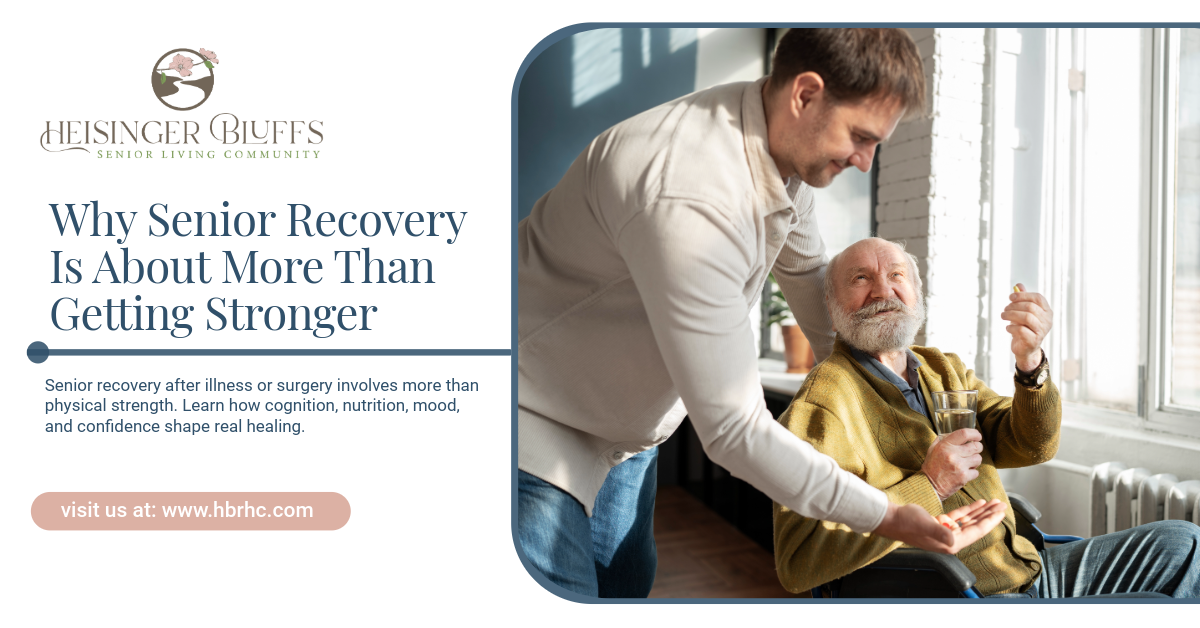
Older adults in recovery need more protein than they typically eat, and many are eating less than usual precisely when they need more. Appetite suppression from medication, altered taste, dental discomfort, low mood, and the simple difficulty of preparing food while impaired all push intake down.
A person doing rehabilitation exercises on inadequate protein and fluid is burning reserves rather than rebuilding. Weight loss during recovery is not a neutral sign. It usually means the body is consuming muscle.
Hydration matters just as much. Dehydration in older adults produces confusion, dizziness, weakness, and falls, and it is often mistaken for cognitive decline.
Any serious recovery program should be tracking weight and intake, not just repetitions.
The Fear That Nobody Charts
After a fall, something changes that no measurement captures. The person becomes afraid.
Fear of falling is one of the strongest predictors of future decline. It causes people to move less, which weakens them, which makes falling more likely, which deepens the fear. The loop is tight, and it closes fast.
The same thing happens after a cardiac event or a stroke. The body is cleared for activity. The person does not believe it. They sit down and stay down.
This is why the distinction between capability and behavior matters so much. In a therapy gym, with a trained professional standing beside them and parallel bars within reach, almost anyone can walk twenty feet. At home, alone, at two in the morning, on the way to the bathroom, the question is entirely different.
Closing that gap requires repeated, supervised practice of real tasks in real settings until the person's confidence catches up with their ability. It is not something that happens in three visits a week.
What We See in Practice
A gentleman came to us for short term recovery after a hip fracture. He arrived with excellent physical therapy notes from the hospital and a discharge summary that described him as progressing well.
For the first week, he did his exercises correctly and cooperatively, then returned to his room and stayed there. He was eating perhaps a third of each meal. He had told his daughter he did not see the point of any of it.
Our team did not add more physical therapy. We changed three other things. We moved him to a table in the dining room with two other residents who shared his background in state government, which meant he was eating while talking rather than eating alone. We adjusted his meal timing and added protein between meals rather than pushing larger portions he had no appetite for. And we had a staff member walk with him to the dining room each day instead of bringing a tray, which turned a meal into a short walk with a purpose.
Within about ten days, his intake had roughly doubled. Within three weeks, he was walking the hallway without being asked, because he had somewhere he wanted to go.
His physical therapy plan never changed. His recovery did.
We have seen this pattern repeatedly. The exercise is rarely the limiting factor. Motivation, nutrition, and connection usually are.
Signs That Recovery Has Stalled
Families often sense that something is wrong before they can explain it. These are the concrete indicators worth acting on:
- Weight is dropping, or clothing has become noticeably loose.
- The person has stopped initiating anything, including phone calls and television choices.
- Confusion is worse in the late afternoon and evening than in the morning.
- Mobility aids are being used more, not less, as weeks pass.
- The person is sleeping during the day and awake at night.
- Bathing or dressing has become inconsistent.
- New medications have been added without anything being removed.
- The person declines visitors they previously welcomed.
Any two of these appearing together deserve a conversation with the physician. Readmissions are rarely sudden. They are usually the end of a decline that was visible for weeks.
What Comprehensive Recovery Support Looks Like
A program that treats recovery as more than strength training will have most of the following in place:
Coordinated Clinical Oversight
Nursing, therapy, and dietary staff communicating about the same resident rather than working in parallel.
Medication Reconciliation
Someone reviewing the full list after discharge, catching duplicates, and watching for side effects that mimic decline.
Nutrition Tracking with Intervention
Weights recorded, intake noted, and a plan that changes when the numbers move the wrong way.
Structured Daily Routine
Consistent wake times, meals at set hours, and activity built into the day rather than offered as an option.
Engagement That Is Actually Engaging
Programming matched to the person's history and interests, not generic entertainment.
Real-World Practice
Therapy that includes getting in and out of a car, managing a shower, and navigating stairs, not only gym-based exercises.
Family Communication
Regular updates and a clear point of contact, so families know what is happening between visits.
A Defined Discharge Plan
Written goals, home safety recommendations, and a plan for what support continues afterward.
Questions to Ask Before Choosing a Recovery Setting
- How many days a week is therapy provided, and for how long each session?
- Who monitors nutrition, and how often is weight recorded?
- How are medications reviewed after admission?
- What happens on evenings and weekends?
- How is progress communicated to the family?
- What is the plan for the transition home, and who builds it?
- What percentage of your short-term residents return home successfully?
The answers will tell you quickly whether a program understands recovery as a whole or as a set of exercises.
Final Thoughts
Recovery for an older adult is never just a matter of rebuilding muscle. It is a coordinated effort involving strength, nutrition, cognition, mood, connection, medication safety, and above all the confidence to live independently again. Programs that treat only the physical piece produce residents who look recovered on paper and struggle in real life.
At Heisinger Bluffs, our short term recovery and rehabilitation team serves families throughout Jefferson City, Missouri, and the surrounding areas with therapy, nursing oversight, dietary support, and daily engagement, working together toward one goal, which is getting your loved one home and keeping them there.
If someone in your family is facing surgery, is currently in the hospital, or is not recovering the way you expected, contact us today to talk through the options and schedule a visit.
Frequently Asked Questions
How long does recovery take for an older adult after surgery or hospitalization?
It varies widely by person and event, but a useful rule is that recovery takes considerably longer than the medical timeline suggests. Physical benchmarks may be met in weeks while appetite, stamina, confidence, and cognition continue improving for months. Expect progress to be uneven rather than linear.
Is short term rehabilitation different from long term care?
Yes. Short term recovery care is goal directed and time limited, with the explicit aim of returning the person home or to their previous living situation. It typically involves daily therapy, nursing oversight, and a defined discharge plan.
Why is my parent more confused after the hospital than before?
This is common and often related to delirium, medication changes, disrupted sleep, dehydration, or the disorienting effect of an unfamiliar environment. It frequently improves with structure, rest, proper nutrition, and time. It should always be discussed with a physician rather than assumed to be permanent.
Can recovery happen at home instead?
Sometimes, particularly with strong family support and reliable home health services. The challenge is that home offers little structure, and the domains that matter most outside of strength, including nutrition, routine, and engagement, are the hardest for a family to sustain around their own work and lives.
What if my parent refuses to participate in therapy?
Refusal is usually a symptom rather than stubbornness. It commonly reflects depression, pain, exhaustion, fear, or a sense that recovery is pointless. Addressing the underlying cause tends to be far more effective than pushing harder on the exercise itself.
Sources:
- https://pmc.ncbi.nlm.nih.gov/articles/PMC3276215/
- https://pubmed.ncbi.nlm.nih.gov/22868834/
- https://www.health.harvard.edu/blog/the-dangers-of-hospital-delirium-in-older-people-201111163810
- https://pmc.ncbi.nlm.nih.gov/articles/PMC8629501/



Share This Article
You May Also Like To Read