
Bringing Kids Along: Visiting a Grandparent in Memory Care

Key Highlights
- Children's visits often spark joy, recognition, and emotional warmth in residents with dementia—even in later stages, making these moments more meaningful than parents often realize.
- Honest, age-appropriate preparation before the visit is the single biggest predictor of whether a child leaves feeling connected or confused.
- Short, sensory-rich activities like singing, looking at photos, or reading aloud work far better than long conversations for both children and their grandparents.
- Difficult moments, being called the wrong name, repeated questions, or sudden mood changes, can be reframed with simple language that protects a child's heart without hiding the truth.
- Processing the experience together afterward helps kids store these visits as memories of love rather than confusion.
- Regular, predictable visits tend to be far more valuable than infrequent, long ones for everyone involved.
Why Bringing Kids Matters More Than You Think
It's easy to assume that a young child wouldn't get much out of a visit with a grandparent who can no longer hold a long conversation, who repeats questions, or who sometimes doesn't remember their name. Many families quietly decide to leave the kids at home, hoping to "spare" them the experience.
But research on intergenerational contact in memory care and decades of observation in dementia communities tell a different story. Older adults living with cognitive change often light up around children in ways they don't with anyone else. Familiar lullabies surface from somewhere deep. A great-grandmother who hasn't spoken in days might hum along to "You Are My Sunshine." A grandfather who confuses his adult son with a stranger may still reach for a four-year-old's hand and hold on.
Children, for their part, tend to take memory loss in stride far better than adults do. They haven't built up the same expectations of who their grandparent "should" be. They meet the person in front of them. That gift, being met without grief or correction, is something families rarely talk about, but it's one of the quietest blessings of these visits.
The visits also matter for the children themselves. Watching a parent love someone whose mind is changing teaches lessons about patience, dignity, and unconditional family bonds that no classroom can deliver. Kids who grow up visiting a grandparent in memory care often grow into adults with stronger empathy skills and far less fear of aging.
Preparing Children Before the Visit
The single biggest factor in how a memory care visit goes isn't the grandparent's good or bad day. It's whether the child knew what to expect.
Children handle hard truths better than vague reassurances. A simple, calm explanation tailored to their age does more than any pep talk on the drive over. Avoid phrases like "Grandma is just a little forgetful" if the reality is more significant—kids notice the gap between what they were told and what they see, and that gap is where anxiety grows.
Here's a framework many families find helpful for what to say at different ages:
| Child's Age | What to Explain | Helpful Phrasing |
|---|---|---|
| 2-4 years | Keep it concrete and short. Focus on what they'll see and do. | "We're going to see Grandpa. He lives in a place where helpers take care of him. We'll sing a song together." |
| 5-7 years | Introduce the idea that the brain can get sick, like other parts of the body. | "Grandma has a sickness in her brain that makes it hard to remember things. She still loves you, even if she forgets your name sometimes." |
| 8-11 years | Add specifics. Prepare them for repeated questions or mistaken identities. | "Grandpa might ask the same question more than once, or call you by Daddy's name. That's the illness, not him being confused about how much he loves you." |
| 12+ years | Treat them as partners. Talk about what they might feel and how to help. | "It can be hard to see Grandma like this. If you need a break during the visit, just tell me. There's no wrong way to feel." |
Beyond words, prepare children for sensory differences too. Memory care neighborhoods sometimes have unfamiliar sounds, alarms, or residents who behave in ways kids haven't seen before. Mentioning this ahead of time—"You might see someone who is upset, or someone walking around, that's normal here," prevents the startled freeze that can derail a visit before it starts.
A small, practical tip: bring something. A drawing the child made, a familiar song queued up on a phone, a few flowers, a photo album. Having an object in hand gives kids a job and a reason to walk through the door, which dramatically reduces first-moment shyness.
During the Visit: What Actually Works
Long conversations are often the wrong tool. Memory care residents frequently lose the thread of dialogue, and children get bored or anxious when adult talk stretches on. The visits that go best are the ones built around brief, sensory, shared activities.
Some that consistently work well:
- Music. Songs from a grandparent's young adulthood, roughly ages 15 to 25, are stored in a deep, well-protected part of the brain. A hymn, a Frank Sinatra standard, a lullaby. Even residents who rarely speak will often sing.
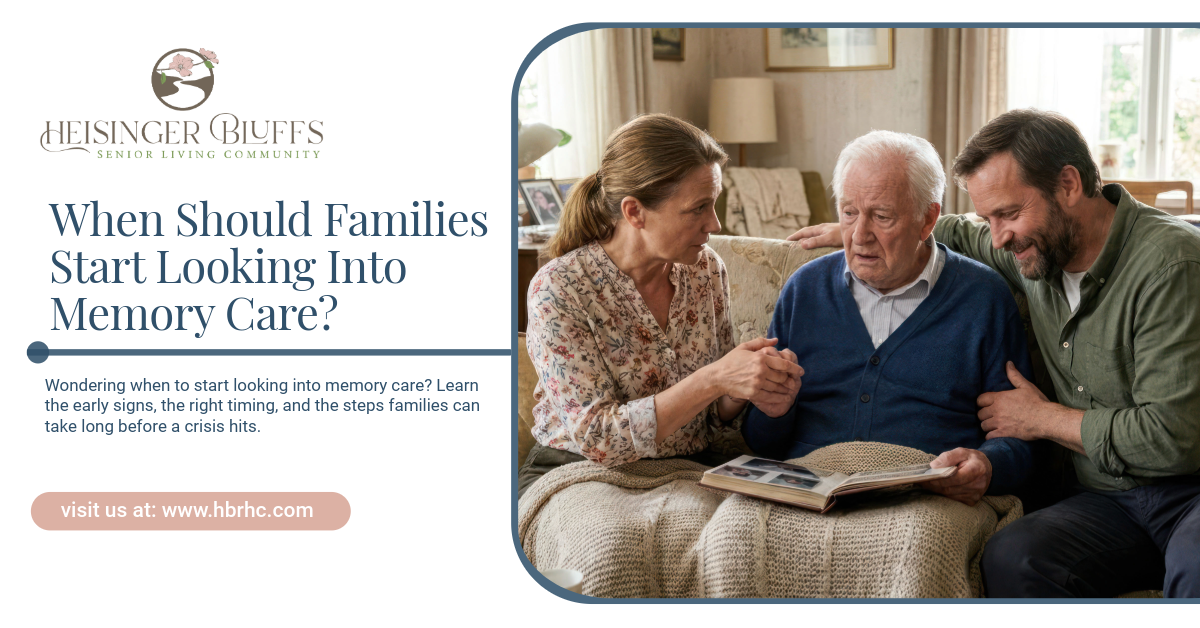
- Photo albums. Old photos prompt stories, and kids love hearing them. The story doesn't have to be accurate or even consistent—what matters is the shared look.
- Reading aloud. Children's books are perfect: short, illustrated, rhythmic. The grandparent doesn't need to follow the plot.
- Simple sorting tasks. Sorting buttons, folding washcloths, matching socks. These soothe both the resident and the child, who naturally enjoys helping.
- Walking together. A loop down the hallway, into the courtyard, around the dining room. Movement carries the visit when conversation can't.
- Small grooming gestures. A child gently brushing Grandma's hair or putting on her favorite hand cream creates closeness without needing words.
Keep the visit short. Twenty to forty minutes is the sweet spot for younger children. Quality and frequency matter much more than length. A thirty-minute visit every other Sunday will leave deeper roots than a two-hour visit once every few months.
Handling the Hard Moments
Even with great preparation, hard moments will happen. A grandparent might not recognize the child. They might say something confusing, ask the same question seven times, or become tearful or agitated.
Here's where parents earn their stripes. Children take their cues directly from the adult next to them. If you stay calm and treat the moment as ordinary, the child usually does too. Here are a few things that help:
If your child is called the wrong name, you don't need to correct it. Just answer to the name. The grandparent feels heard, the child sees you model gentleness, and no one is hurt. Afterward, in the car, you can simply say: "When Grandpa called you Tommy, that was Daddy's name when I was little. His brain pulled up the wrong file. He still loves you."
If a question is repeated, let your child know in advance that this is okay, and maybe even funny in a loving way. We've worked with one family whose seven-year-old turned the repetition into a small ritual: each time her great-grandmother asked, "And who do you belong to?" the little girl would proudly say, "I'm Sarah's daughter, Grandma!" By the fourth or fifth time, she was beaming. The repetition had become a connection.
If the grandparent becomes upset, don't argue with the content of their distress. If they insist they need to go pick up their children from school, don't say, "Your kids are grown." Try, "Tell me about them. What were they like at that age?" Redirection through curiosity almost always works better than correction.
In our experience, the families who navigate hard moments best are not the ones who avoid them—they're the ones who treat them as part of the visit, not an interruption to it.
After the Visit: The Conversation in the Car
The drive home is where children make sense of what just happened. Don't skip it.
Open with something simple and low-pressure: "What was your favorite part?" or "Was there anything that felt funny or weird?" Let the child lead. Resist the urge to immediately reframe everything into a lesson.
If the child seemed unsettled, name it gently. "It looked like it surprised you when Grandma cried. That happens sometimes. It wasn't because of you." Children often carry private worries that they caused something or did something wrong. A few seconds of plain reassurance can prevent weeks of quiet anxiety.
For older kids, this is also a chance to share their own feelings honestly. "It was hard for me, too, when Grandpa didn't remember my name at first. But by the end, when we sang together, I felt close to him again." Modeling that complicated feelings can sit side-by-side with love is one of the most valuable things a parent can teach.
Some families like to close the loop with a small ritual—stopping for ice cream, drawing a picture for the next visit, or writing one sentence about what happened in a little notebook. These practices turn visits into a thread the child can hold, instead of disconnected events.
Building a Sustainable Rhythm
Many families start strong and then taper off, especially as a grandparent's condition progresses. This is understandable. But predictability is one of the kindest gifts you can give both your child and your loved one.
Pick a rhythm you can actually keep. Every other Sunday afternoon. The first Saturday of every month. After school, once a week if you live nearby. Whatever fits, treat it like a standing appointment, not an errand to schedule. Children thrive on this kind of structure, and over time, the visit becomes part of who they are rather than something heavy on the calendar.
Also, give yourself and your child permission for the occasional skipped visit. A sick week, a school project, a hard day. Memory care is a long road, and sustainability matters more than perfection.
A Place Where Family Visits Feel Like Family Visits
Bringing a child to see a grandparent in memory care is rarely something families feel fully ready for. But with a little preparation, the right environment, and small, sensory-rich moments, these visits can become some of the most meaningful chapters of a child's life, and a real source of joy for the resident.
At Heisinger Bluffs in Jefferson City, Missouri, we've spent years walking alongside families through exactly these moments. Our memory care community is designed to feel like a home where grandchildren are welcomed, not just permitted: comfortable common spaces, quiet visiting nooks, intergenerational programming, and a team trained to help families navigate the harder days with grace.
If you're considering memory care for a loved one, or wondering what a healthy visit rhythm could look like for your family, we'd be glad to talk. Contact us today or schedule a tour to see how we support residents and the families who love them.
Frequently Asked Questions
At what age can I start bringing my child to visit a grandparent in memory care?
There's no minimum. Babies and toddlers are often delightful for residents and don't yet have the same fears older children do. The key is matching the visit length to your child's attention span and your loved one's energy level. For very young children, fifteen to twenty minutes may be plenty.
What if my child says they don't want to go?
Listen first—there may be a specific worry you can address (a smell, a fear of a certain hallway, an upsetting memory from a past visit). Try not to force a child who is genuinely frightened, but don't let avoidance harden into a pattern. Often, a smaller commitment works: "Let's just go for ten minutes and bring the picture you drew." Children almost always feel better once they're inside and engaged.
How do I explain it if my child's grandparent passes away soon after a visit?
Children who have visited regularly tend to grieve more openly and heal more cleanly than those who were kept away. They have something concrete to hold onto—songs you sang, things you did. When the time comes, be honest, use clear language ("died," not "passed" or "went to sleep"), and let them participate in goodbyes in age-appropriate ways.
Should I bring my child if their grandparent is in late-stage dementia and mostly nonverbal?
Yes, if you and your child are open to it. Touch, music, and presence still register, even when speech is gone. Many families describe these later visits as some of the most peaceful. Keep them brief, lead with sensory connection (a hand on top of theirs, a familiar song, reading aloud), and trust that being there means something even when nothing visible happens.
My child asks hard questions I don't know how to answer. What should I do?
That's a really good question. Let me think about it" is a perfectly acceptable answer. Children don't need polished responses; they need honest, attentive ones. It's also okay to say, "I don't know, but I love you, and we'll figure this out together."
Sources:
- https://pmc.ncbi.nlm.nih.gov/articles/PMC8859040/
- https://www.sciencedaily.com/releases/2017/04/170410085003.htm
- https://www.cottagelitchfield.com/blog/intergenerational-programs-in-senior-living
- https://www.alzinfo.org/treatment-care/blogs/2011/11/role-children-alzheimers-care/
- https://www.alzheimers.org.uk/dementia-together-magazine/june-july-2018/little-visitors-people-dementia-spending-quality-time



Share This Article
You May Also Like To Read