
Key Highlights
- Trust is the most important factor in choosing a senior living community because you're entrusting someone else with daily care and comfort.
- Real trust comes from transparent pricing, consistent staff, honest communication, and a safe environment, not from a polished brochure.
- How a team answers hard questions tells you more than any tour highlight.
- Return visits, conversations with residents and families, and licensing records help you verify what you are told.
- Your loved one's comfort and voice belong at the center of the decision.
- Trust must keep being earned after move-in through steady communication and follow-through.
- A comparison table and question checklist below help you evaluate communities side by side.
Why Trust Comes Before Everything Else
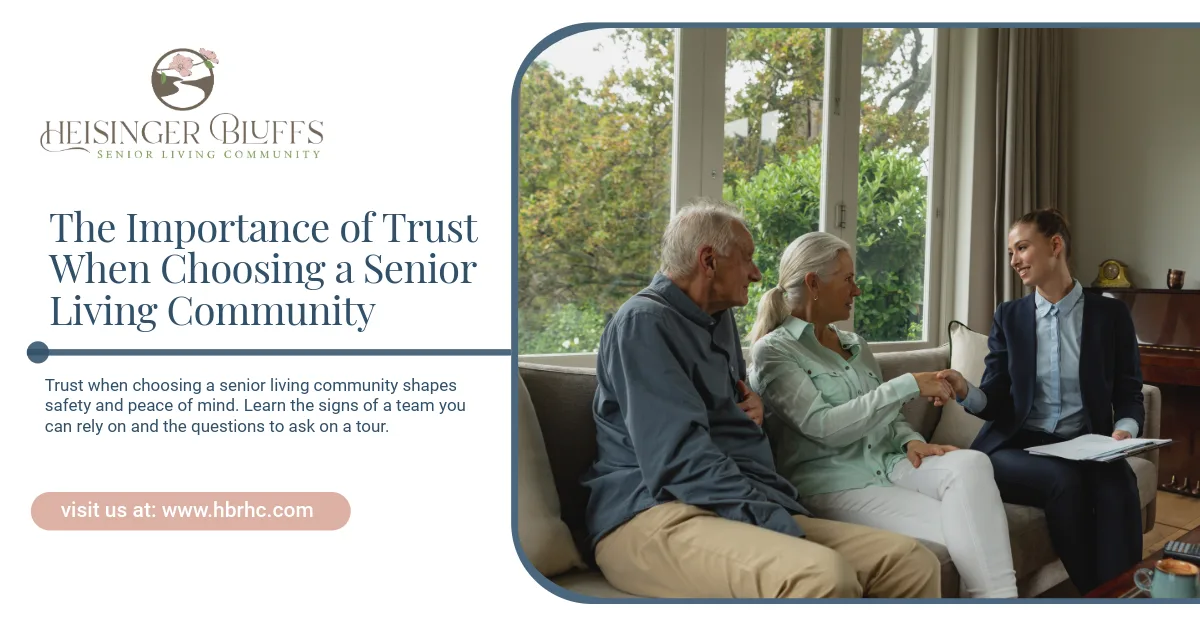
Choosing a senior living community is one of the most emotional decisions a family will make. You are not just comparing floor plans and dining menus. You are deciding who will be present for your parent, spouse, or loved one on an ordinary Tuesday morning, on a difficult night, and on the day something unexpected happens. That is why trust when choosing a senior living community matters more than any amenity list or price point.
Most families begin with practical questions. What does it cost? How far is it from home? What do the apartments look like? These are fair questions, but they only tell part of the story. Underneath every practical question sits a quieter one: can we count on these people?
Moving to senior living means placing routines, health needs, safety, and dignity in the hands of others. Even in settings built for independence, residents rely on staff for security, maintenance, meals, and emergency response. Families feel the weight of that reliance. Adult children often carry guilt about the move itself and want reassurance that they chose well. Older adults may feel they are losing control and need to believe the people around them will respect their preferences.
Trust turns a stressful transition into a hopeful one, and it has practical effects:
- Residents who trust their caregivers tend to speak up sooner when something feels wrong.
- Families who trust the team raise small concerns early, before they become large ones.
- Staff who feel supported by leadership tend to stay longer, and familiar faces are one of the most valuable things a resident can have.
What Trust Actually Looks Like
Trust is not a feeling a community can manufacture with good marketing. It is the result of everyday behavior you can observe. Here are the five pillars to look for.
1. Transparency About Costs and Services
A trustworthy community explains what is included in the monthly fee, what costs extra, and how and when prices can change. You should receive this in writing, and the team should welcome your questions about it. Vague answers such as "we'll work it out later" are a reason to slow down. Families deserve to know the full financial picture before signing, not after.
2. Consistent, Familiar Staff
Ask how long team members have worked there and how they are trained. Frequent turnover makes it hard for anyone to learn a resident's habits, preferences, and small changes in health. When you tour, notice whether staff seem to know residents by name and whether the interactions feel warm or rushed.
3. Open and Timely Communication
Find out who your point of contact will be and how the team keeps families informed, both for good news and for concerns. A community you can trust tells you about a fall, a change in appetite, or a schedule change before you have to ask. The way they communicate during the sales process is often a preview of what follows.
4. A Safe, Well-Maintained Environment
Look past the lobby. Are hallways clear and well lit? Do call systems, handrails, and outdoor areas look cared for? Small maintenance issues, like burned-out bulbs or stained carpets left unattended, can signal how seriously a community treats bigger responsibilities.
5. Respect for Dignity and Choice
Residents should be treated as adults with preferences, histories, and opinions. Watch how staff knock before entering, how they speak to residents, and whether residents have real choices about their day, from meals to activities to when they wake up. Dignity is one of the clearest trust signals you can observe in person.
Trust Signals and Red Flags at a Glance
Use this table on your tours to compare communities honestly.
| What You Are Evaluating | Trust Signal | Red Flag |
|---|---|---|
| Pricing | Written, itemized, and explained patiently | Vague answers or pressure to decide quickly |
| Staff | Longtime team members who know residents by name | Frequent turnover and hurried, impersonal interactions |
| Your questions | Direct, honest answers, including "I don't know yet, let me find out" | Deflection, overpromising, or defensiveness |
| The tour | Open to return visits at different times of day | Only scheduled, tightly controlled walk-throughs |
| Communication | A clear point of contact and a set process for updates | No defined process for reaching leadership |
| Residents | Engaged, comfortable, willing to chat | Isolated, ignored, or visibly uneasy |
How to Test Trust During Your Search
Brochures and websites tell you what a community wants you to see. These steps help you see the rest.
- Visit more than once. Go at different times of day, including a mealtime and, if possible, an evening or weekend. Consistency across visits is a strong sign.
- Talk to residents and families. Ask what they wish they had known and how the team responds when something goes wrong.
- Ask about turnover and training. A confident team answers plainly. You are looking for honesty more than perfection.
- Read every agreement carefully. Ask about discharge or transfer policies, rate increases, and what happens if care needs change.
- Check licensing and inspection records. Missouri families can start with the Missouri Department of Health and Senior Services, and the state's Long-Term Care Ombudsman program is a resource for questions about resident rights.
- Notice how concerns are handled. Ask for an example of a family complaint and how it was resolved.
A few questions worth bringing with you:
- How do you communicate with families when a resident's needs or health change?
- What happens if my loved one needs more support than they do today?
- How do you gather and act on resident and family feedback?
- Who can I speak with directly if I have a concern?
- What would you want us to know before making this decision?
Pay attention to the answers, but also to the tone. A team that is proud of its work and honest about its limits is far easier to trust than one that claims to do everything perfectly.
A Real Example: What We Have Seen Families Notice
In our tours and conversations with families, we have seen the same pattern repeat. One daughter toured with her father, who was hesitant about leaving his home. She arrived with a spreadsheet comparing amenities. What changed her mind was small. During the walk-through, a team member stopped to greet a resident by name and asked how her knee was feeling, remembering it from the day before. Later, the daughter asked what would happen if her father's needs changed. The team member did not deflect. She explained what was possible, what would require a conversation, and what she did not yet know.
The daughter later told us that the honest "I would want to look at that with you" did more to earn her confidence than any brochure. Her father noticed too. He said the place felt like people actually knew each other.
We hear a similar theme in many of our family conversations. People rarely say, "The dining room won me over." They say, "Everyone seemed to know what they were doing, and they were honest with us." That is trust, and it is worth prioritizing above nearly everything else.
Consider the opposite scenario, which many families describe to us after a previous experience elsewhere. A community looked beautiful and offered generous promises during the sales process. Once the move happened, questions took days to answer, and staff changed so often that the family had to re-explain their mother's routines again and again. Nothing dramatic went wrong. Trust simply never had the chance to form, and the family spent months worrying instead of relaxing.
Include Your Loved One in the Decision
Trust has to work for the person who will live there, not only for the family arranging the move. Invite your loved one to tour, eat a meal, and meet the team. Ask what they noticed and how they felt. Some people know within minutes whether a place feels welcoming, and their instincts deserve weight.
If your loved one is reluctant, listen to why. Fear of losing independence, worry about being a burden, and grief over leaving a longtime home are common. A trustworthy community will not brush those feelings aside. It will acknowledge them and show, through patience and respect, that moving in does not mean giving up a sense of self.
Trust Is Earned Again Every Day After Move-In
Signing the agreement is not the end of the trust process. In the first weeks, check in often. Notice whether the team follows through on what they promised, whether your loved one is settling in socially, and whether communication matches what you were told during the tour. Ask for a care or service review after the first month, and speak up early about small concerns.
A community worth trusting welcomes that feedback, because it shows you care and gives them the chance to respond. It also helps to keep a simple running list of what you were promised during the tour, such as communication schedules, routines, and preferences. Reviewing that list together after a few weeks keeps everyone accountable and makes it easy to celebrate what is going well. Over time, small moments of follow-through build the kind of confidence no sales conversation can create.
Choose a Team You Can Trust
Trust is the foundation of a good senior living decision. It shows up in honest pricing, familiar faces, open communication, a safe environment, and respect for every resident's dignity.
At Heisinger Bluffs, we understand how much is riding on this choice, and we believe you should feel confident in it. Our team is proud to serve families in Jefferson City, Missouri, and we welcome your questions, your return visits, and your hardest what-ifs.
Contact us today to schedule a tour, meet our team, and see for yourself what a community built on trust feels like.
Frequently Asked Questions
How do I know if a senior living community is trustworthy?
Look for transparent pricing, consistent staff, direct answers to hard questions, and a willingness to let you visit more than once. Verify what you are told by talking with residents and families and reviewing licensing and inspection records.
What questions should I ask during a tour?
Ask how the team communicates with families, what happens if care needs change, how staff turnover is handled, and who to contact with a concern. The quality of the answers, and the honesty behind them, matter as much as the content.
Is it a bad sign if a community will not give exact pricing right away?
Not always, since some costs depend on individual needs. But a trustworthy community will explain how pricing is determined, put it in writing, and never pressure you to commit before you understand it.
Should my loved one be involved in choosing the community?
Yes, whenever possible. Their comfort, preferences, and first impressions are essential. A move they feel part of usually leads to a smoother transition.
What if I feel uneasy after moving in?
Raise it early with the point of contact you were given, and ask for a meeting to discuss it. If you need additional support, the Missouri Long-Term Care Ombudsman program can help with questions about resident rights.
Sources:
- https://www.providermagazine.com/Issues/2025/Winter/Pages/Building-Trust-in-Long-Term-Care.aspx
- https://aptura.directsupply.com/resources/blogs/impressions-family-trust
- https://americanretirementhomes.org/how-assisted-living-staff-build-trust-and-long-term-relationships/
- https://pmc.ncbi.nlm.nih.gov/articles/PMC8807332/