
Key Highlights
- Purpose is not a soft, feel-good extra. Long-running studies link a strong sense of purpose in older adults to slower cognitive decline, lower disability risk, and longer life.
- Purpose tends to erode quietly in later life, not through one dramatic loss but through the gradual disappearance of roles, deadlines, and people who depend on you.
- The biggest risk in any care setting is being helped too much. Classic research found that residents given real responsibility and real choice fared measurably better than those who were simply well cared for.
- Purpose after 75 rarely looks like a grand mission. It looks small, specific, and recurring, which is exactly why it is easy to overlook and easy to build.
- A well-designed community removes draining obligations like home maintenance and frees capacity for chosen contribution, rather than replacing doing with being done for.
- A full activities calendar is not the same thing as purpose, and the difference is worth knowing before you tour anywhere.
Purpose Is Not a Soft Benefit
For a long time, "sense of purpose" sat in the category of things that are nice to have but hard to measure. That is no longer a fair description of the evidence.
Researchers at the Rush Alzheimer's Disease Center have followed thousands of older adults for years through the Memory and Aging Project and the Minority Aging Research Study, measuring purpose in life at baseline and then tracking what happened. The pattern that emerged has been consistent across multiple published analyses.
Older adults reporting greater purpose showed a substantially lower risk of developing Alzheimer's dementia and mild cognitive impairment. They had a reduced risk of becoming disabled in basic daily activities and in mobility. And they had lower all-cause mortality over the follow-up period.
One finding is particularly striking. In a study that combined annual cognitive testing with brain autopsy, researchers found that purpose appeared to buffer the relationship between Alzheimer's pathology and actual cognitive function. Put plainly, among people with similar levels of physical disease in the brain, those who had reported a stronger sense of purpose were functioning better than the pathology alone would predict.
These are observational studies, and observational studies cannot prove that purpose causes better outcomes. It is entirely plausible that some of the relationship runs the other way, with healthier people finding it easier to feel purposeful. But the associations have held up across large samples, long follow-up periods, and statistical adjustment for depression, education, chronic conditions, and social activity. At minimum, purpose is a serious variable in how well people age, not a decorative one.
Why Purpose Quietly Erodes
Purpose is rarely lost all at once. It drains away through a series of individually reasonable subtractions.
Work ends, and with it goes a daily reason to be somewhere, a set of colleagues, a problem that needed solving, and an easy answer to the question of what you do. Children grow up and become competent adults who no longer need advice. Driving narrows and then stops, and the committee, the congregation, and the volunteer shift become logistically difficult. Friends move or die. A spouse becomes ill, which supplies enormous purpose, and then the spouse dies, which removes it all at once.
By the mid-eighties, many people have lost most of the external structures that used to generate purpose automatically. Nothing has gone wrong. It is simply that the scaffolding came down faster than anyone replaced it.
There is a second, less obvious cause, and it is one worth naming honestly because it happens inside families who are doing their best. When an older adult starts to struggle, the loving response is to take things over. Adult children handle the bills, the shopping, the cooking, the appointments, and the phone calls. Every individual decision is kind. The cumulative effect is that the person has nothing left that is genuinely theirs to do. Being cared for expertly and having no role are a surprisingly easy combination to end up in.
The Research That Changed How Good Communities Are Designed
In the 1970s, psychologists Ellen Langer and Judith Rodin ran a study at a Connecticut nursing home that has shaped the field ever since. Residents on one floor were given real responsibility. They were told the room was theirs to arrange, that decisions about their days were up to them, and they were each given a plant to choose and care for themselves. Residents on a comparison floor received the same pleasant environment and the same plant, but staff emphasized that the team was there to take care of things, including watering the plant.
The residents given responsibility showed higher self-reported happiness, greater activity levels, and better nurse-rated improvement within weeks. At an 18-month follow-up, the difference in health ratings persisted, and the researchers reported a mortality difference between the groups.
It is worth being straightforward about the limitations. This was a small early study by modern standards, and researchers have since questioned how much weight the mortality figure specifically can bear. The lasting contribution is not the number. It is the principle, which decades of subsequent work on perceived control and depression in older adults has supported: taking away someone's responsibility, even generously, has a cost.
This is why the question to ask about any senior living community is not "how much do they do for residents." It is "how much do residents still get to do."
What Purpose Actually Looks Like After 75
A great deal of writing on this topic sets the bar impossibly high, as though purpose requires founding something or leaving a legacy. In practice, the purpose that sustains people in their eighties is almost always small, specific, and recurring.
It looks like being the person who saves a seat for someone who eats alone. Being the one who knows how the coffee machine works and shows the new people. Watering the herbs on the patio because nobody else will. Reading to a great-grandchild over video every Sunday at four. Keeping the crossword going with the same partner for eleven years. Teaching someone to knit badly and then better.
The common features are worth noting, because they tell you what to build:
- Someone would notice if you did not do it. This is the single most important ingredient.
- It repeats. A one-time event is a nice afternoon. A standing commitment is a role.
- It is chosen, not assigned. Purpose requires ownership.
- It involves other people. Purely solitary activity can be satisfying but rarely produces the same effect.
How a Well-Designed Community Builds This Into an Ordinary Day
Here is the objection worth confronting directly, because most families feel it: does moving into senior living not reduce purpose by taking everything off your plate?
It can, if the community is designed poorly. Done well, the opposite happens. Most of what fills an older adult's day at home is obligation, not purpose. Gutters, insurance renewals, grocery runs that take two hours, meals cooked for one, a lawn that has become a source of anxiety. That work is genuinely draining and produces almost no meaning. Removing it does not empty a life. It frees the capacity that purpose actually requires.
| Mechanism | What It Looks Like Day to Day | What It Replaces |
|---|---|---|
| Real contribution | Resident-led committees, welcome roles for new arrivals, garden beds tended by residents, volunteering coordinated through local organizations | Being a recipient of services and nothing more |
| Structure and rhythm | Standing weekly commitments, shared mealtimes, a class that meets whether or not you feel like it | Shapeless days where nothing is expected of you |
| Autonomy and choice | Choosing your own schedule, your own apartment layout, when to eat, when to be alone | Decisions made on your behalf, however kindly |
| Growth and mastery | Classes, instruments, languages, technology instruction, art studios where the work gets better over time | The assumption that learning has ended |
| Being needed | Friendships that expect you, a walking partner, a neighbor who counts on the check-in | Social contact that is pleasant but optional |
| Continuity of identity | Space to keep doing what you always did, whether that is woodworking, teaching, or hosting | Being defined only by what you now need help with |
Notice that most of these depend on something a house cannot easily supply, which is proximity. Purpose requires other people who are close enough that participation is not a logistical project. When the walking partner is thirty steps away rather than a twenty-minute drive, the commitment survives a bad knee day.
What We Have Seen
We can speak to this from direct experience with residents.
A few years ago, a gentleman moved in after his wife's death and a hard year of living alone. He had been a high school shop teacher for three decades. In his first months, he was polite, showed up for meals, and went straight back to his apartment afterward. He was, by every visible measure, adjusting fine. He also was not really present.
What changed was not a program. It was a broken drawer slide in the craft room. Someone mentioned it in front of him, he offered to look at it, and he fixed it that afternoon. Within a few weeks, he had a running list of small repairs, most of which our maintenance team could have handled faster. We deliberately did not handle them faster. By the following spring, he was running an informal Thursday workshop, teaching two other residents and, eventually, a couple of grandchildren who came on visits. His daughter told our team that his phone calls had changed entirely, from updates about his health to complaints about the quality of modern hinges.
We have seen versions of this many times. The pattern is almost always the same. The turning point is not an activity someone attends. It is the moment a person becomes responsible for something that other people rely on.
What to Look For When You Visit
Purpose is easy to advertise and harder to build, so it helps to know what actually reveals it. On a tour, an activities calendar full of colorful boxes tells you very little. These questions tell you more:
- What here is run by residents rather than for them? Ask for specific examples and names of the groups.
- What can a resident decide entirely on their own? Meal times, room arrangement, daily schedule, and whether to participate at all.
- How does the team learn what someone did before they arrived? Communities that build purpose well treat a person's history as operational information, not biography for the file.
- What happens when a resident wants to start something new? The answer reveals whether initiative is welcomed or managed.
- Who would notice if a particular resident stopped showing up? If the answer is only "staff," the social fabric is thinner than it looks.
Final Thoughts
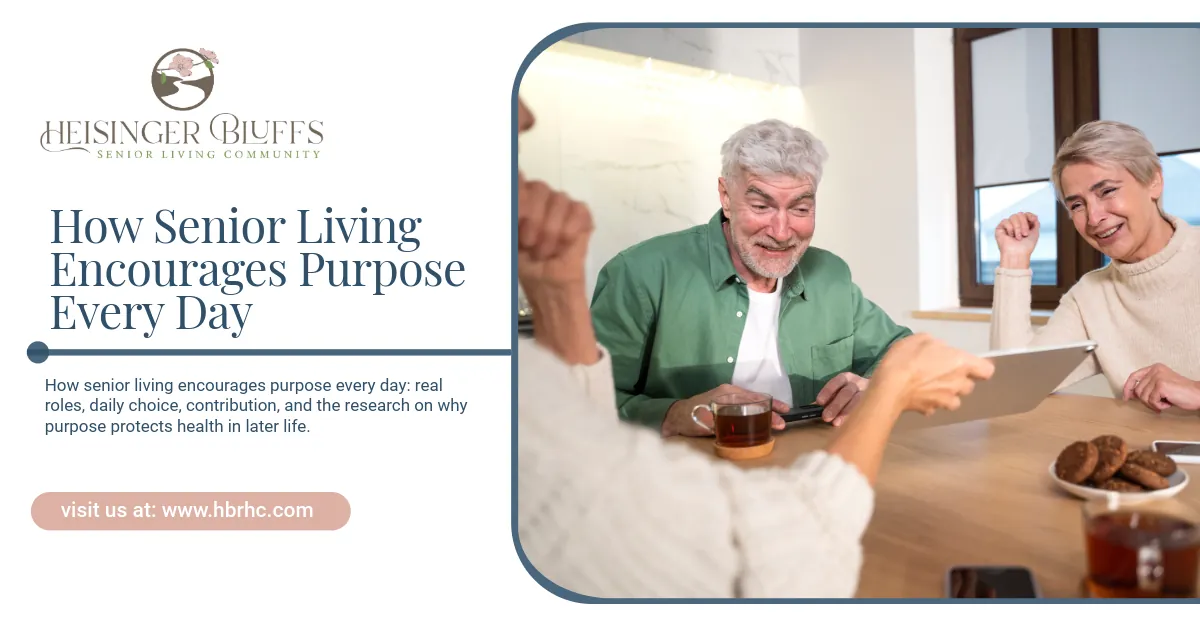
Purpose in later life is built from ordinary, repeated things: a responsibility that is genuinely yours, a routine someone else counts on, the freedom to choose your own day, and people close enough that showing up is easy.
At Heisinger Bluffs, that principle shapes how we do our work. Our team takes the time to learn what each resident did, made, taught, or cared for long before they arrived, and we build daily life around keeping those threads alive, whether through resident-led groups, opportunities to contribute, or simply protecting a person's right to decide how their day goes. With independent living, assisted living, and skilled nursing available in one community, residents can receive more support over time without losing the roles and routines that make life feel like theirs.
We are proud to serve older adults and their families in Jefferson City, Missouri, and throughout the surrounding Mid-Missouri area. If you want to see what a purposeful day actually looks like here, rather than read about it, contact us today to schedule a visit and spend some time with the people who live it.
Frequently Asked Questions
Isn't moving to senior living the opposite of independence?
Most people find it works the other way. Independence is not the same as doing every chore yourself. Removing home maintenance, yard work, and cooking obligations tends to free time and energy for the things a person actually chooses to do, and having support nearby often extends the period during which those choices remain possible.
My parent has never been a joiner. Will this work for them?
Purpose does not require group participation. Plenty of residents find it through one friendship, a single responsibility, a craft, or regular contact with family. The important thing is that the community makes room for individual routes rather than treating attendance as the only measure.
Is it too late if someone has already withdrawn?
Usually not, though it takes longer. Withdrawal after a loss or a move is extremely common and often temporary. The more effective approach is a specific, small, real request rather than a general invitation to participate.
Does this apply to residents living with dementia?
Yes, with adaptation. Familiar, repeated, meaningful tasks such as folding, sorting, gardening, music, and caring for something continue to provide real engagement well into cognitive decline. The purpose is in the doing, not in remembering having done it.
How long does it take for someone to settle in and find their footing?
Commonly a few months. The first weeks are logistics, the next stretch is orientation, and roles tend to form in the three to six month range. Families who expect an immediate transformation often worry unnecessarily.
Sources:
- https://www.rush.edu/news/lifelong-learning-may-decrease-alzheimers-risk
- https://www.foxnews.com/health/new-alzheimers-blood-test-predicts-develop-dementia-5-10-years
- https://pmc.ncbi.nlm.nih.gov/articles/PMC10151065/
- https://pmc.ncbi.nlm.nih.gov/articles/PMC3439198/
- https://www.miragenews.com/research-reveals-superaging-not-merely-1714811/