
Key Highlights
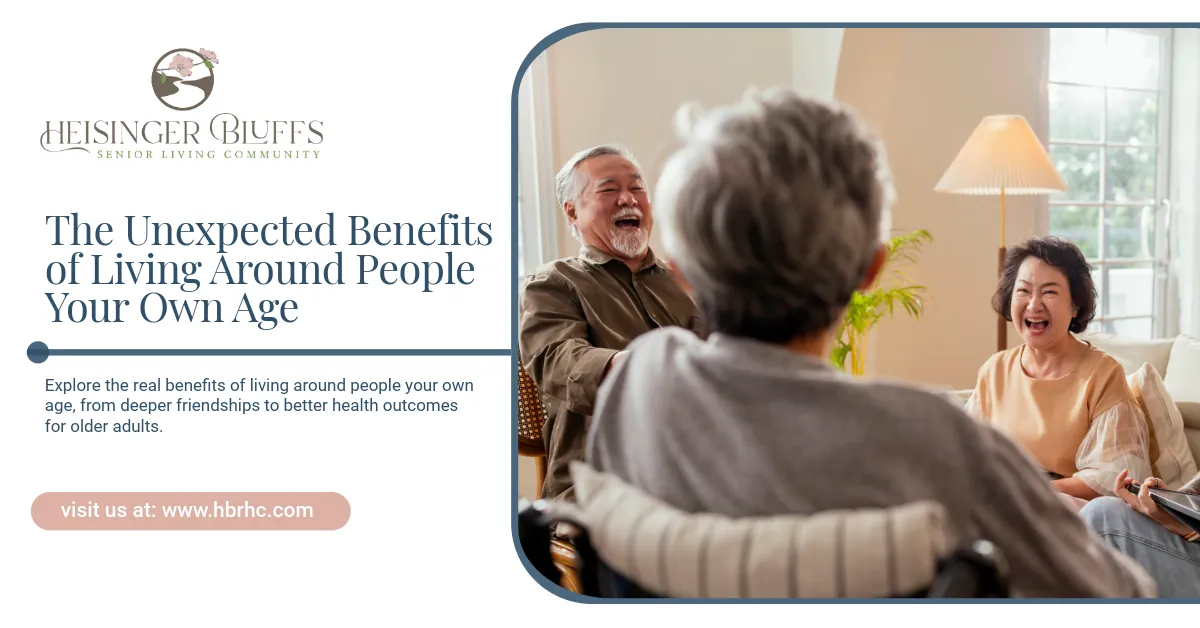
- Living around people your own age often leads to deeper, faster friendships than mixed-age environments typically allow.
- Shared life stage and shared experiences create a natural sense of understanding that reduces social friction and isolation.
- Peer environments have been linked to better mental health outcomes, including lower rates of depression and loneliness in older adults.
- Physical activity, learning, and social participation all tend to increase when surrounded by peers at a similar life stage.
- A comparison of mixed-age versus peer-focused living highlights where each environment tends to fall short or succeed.
- Real examples show how peer connection often reawakens social confidence that had quietly faded over time.
When people picture aging well, they often picture staying close to family, in a familiar neighborhood, surrounded by people of all ages. That instinct makes sense. But there's a less discussed factor that plays a surprisingly large role in how satisfying and healthy someone's later years actually are: being surrounded by peers who are genuinely at the same stage of life.
This isn't about excluding younger generations or stepping away from family. It's about recognizing that peer connection, specifically with people navigating similar life transitions, similar physical realities, and similar available time, offers something that mixed-age environments often can't replicate. This article explores exactly why that matters, what the research shows, and how it plays out in daily life.
Why Shared Life Stage Matters More Than People Expect
Friendship at any age is built on shared experience. But the shared experiences available to someone in their 70s or 80s are simply different from those available to a 35-year-old neighbor or a 20-something grandchild. Conversations about retirement, health changes, the loss of a spouse, adjusting to new routines, or navigating grandparenthood land differently when the person listening has lived through something similar.
This isn't a small detail. Shared life stage removes a layer of explanation that's otherwise necessary in cross-generational relationships. There's no need to explain what it feels like to retire after 40 years in the same career, or what it's like to lose close friends to illness, when the person across the table already understands it firsthand.
That understanding creates a different quality of connection, one that tends to form faster and run deeper than relationships built primarily around proximity or family obligation.
The Research Behind Peer Connection and Aging
Social connection has long been recognized as one of the strongest predictors of healthy aging, but the type of connection matters as much as the amount. Research on aging populations has repeatedly shown that peer relationships, specifically, contribute meaningfully to emotional well-being.
The National Institute on Aging has identified social isolation and loneliness as significant risk factors for a range of health issues in older adults, including cognitive decline, depression, and even cardiovascular disease. What's notable is that the quality and relatability of social contact appears to matter, not just its frequency.
A short, surface-level interaction with a much younger neighbor doesn't provide the same protective benefit as a genuine, relatable conversation with someone facing similar daily realities. Peer environments make that second type of interaction far more likely to happen naturally and often.
Specific Benefits That Emerge From Peer-Based Living
Faster, Deeper Friendship Formation
When everyone around you is navigating a similar stage of life, whether that's newly retired, adjusting to a health change, or simply looking for more social connection, common ground forms quickly. Friendships that might take years to develop in a mixed-age neighborhood often form within weeks in a peer-centered environment, simply because the starting point of understanding is already there.
Reduced Social Pressure and Comparison
Cross-generational environments sometimes carry subtle social pressure, keeping up with younger neighbors' pace of life, feeling out of step with technology, or feeling like a burden when needing help with something physical. Peer environments tend to reduce that pressure significantly, since everyone is navigating similar physical and lifestyle realities.
Increased Participation in Activities
People are more likely to try a new class, join a group outing, or attend a social event when they see peers doing the same. Age-similar environments create a kind of social momentum that mixed-age settings often lack, where one person's willingness to participate encourages others to join in.
Better Emotional Support During Difficult Transitions
Grief, health changes, and major life transitions are easier to process with people who have been through something similar. Peer environments naturally provide this kind of support network, often without anyone needing to formally organize it.
Mental Sharpness Through Regular Social Engagement
Conversation itself is a form of cognitive engagement. Regular, relatable social interaction, the kind that flows naturally in a peer environment, keeps the mind active in a way that occasional or superficial interaction doesn't.
Mixed-Age Living vs. Peer-Focused Living
| Factor | Mixed-Age Neighborhood | Peer-Focused Community |
|---|---|---|
| Speed of friendship formation | Often slower, less shared context | Typically faster, built on shared experience |
| Understanding of life-stage challenges | Limited, requires more explanation | Immediate and mutual |
| Social pressure or comparison | Can be present (pace of life, technology, ability) | Generally reduced |
| Participation in group activities | Depends on individual initiative | Often driven by social momentum |
| Emotional support during transitions | May rely heavily on family | Naturally available through peers |
| Risk of isolation | Higher if family visits are infrequent | Lower due to built-in daily contact |
| Sense of belonging | Varies by neighborhood dynamics | Frequently stronger and more immediate |
This comparison isn't meant to suggest mixed-age environments have no value; family closeness and multi-generational contact remain important. But it does highlight a gap that peer-focused environments are uniquely positioned to fill.
What This Looks Like in Practice
We've seen this play out clearly with new residents who arrive quietly, sometimes hesitant, having spent the last few years in a home where most of their neighbors were decades younger and busy with their own careers and children. Within the first month, it's common to see those same residents joining a card game, walking group, or dinner table conversation that simply wouldn't have happened in their previous neighborhood, not because their previous neighbors were unkind, but because there wasn't a natural, obvious point of connection.
In our experience, one of the clearest signs of this shift is participation. Residents who describe themselves as "not really a group person" before moving often end up attending regular activities within a few weeks, largely because the people around them are asking similar questions, facing similar days, and genuinely interested in spending time together. The social effort required to connect drops significantly when the starting point is already shared.
We've also seen how peer environments help during harder moments, like the loss of a spouse. Residents navigating grief often find unexpected comfort in neighbors who have been through the same experience and understand, without needing an explanation, what that adjustment feels like.
Addressing the Common Concerns
"Won't I miss being around younger people and children?"
Most peer-focused communities don't eliminate contact with younger generations; family visits, grandchildren, and multi-generational events remain part of life. What changes is the daily, default social environment, not family connection.
"Isn't it isolating to only be around people my own age?"
The opposite tends to be true. Research and firsthand experience both point to peer environments reducing isolation, not increasing it, because shared understanding makes connection easier to initiate and maintain.
"What if I don't naturally make friends easily?"
Peer environments tend to lower the barrier to entry for socializing. Shared daily routines, common areas, and group activities create natural, low-pressure opportunities to connect, even for people who describe themselves as more reserved.
How to Evaluate Whether Peer Living Is Right for You
If you're weighing this kind of move for yourself or a parent, a few honest questions can help clarify the decision:
- Has social isolation been a growing concern in the current living situation?
- Are there regular, meaningful opportunities for connection in the current neighborhood?
- Would having built-in daily contact with peers reduce reliance on family for social interaction?
- Is there hesitation about starting new friendships later in life, and would a naturally social environment help ease that?
Honest answers to these questions often reveal more than a simple pros-and-cons list, particularly around emotional wellbeing, which is harder to quantify but just as important as physical health.
Bringing It All Together
Living around people your own age offers something easy to underestimate until it's actually experienced: faster friendships, more natural participation in daily life, and emotional support that flows without needing to be explained. It doesn't replace family connection; it complements it, filling a gap that mixed-age environments often leave open.
At Heisinger Bluffs, we see the impact of this kind of peer connection every day among our residents in Jefferson City, Missouri. Our community is built around shared experience, daily connection, and the kind of natural friendship that makes each day feel a little fuller.
If you're curious what that could look like for you or someone you love, contact us today to schedule a visit and meet the community firsthand.
Frequently Asked Questions
Does living around people my own age mean less contact with family?
No. Peer-focused communities typically encourage and support regular family visits and multi-generational activities. What increases is daily peer contact, not a reduction in family connection.
Is peer-based living only helpful for very social people?
Not at all. In fact, more reserved individuals often benefit significantly, since peer environments lower the effort required to start a conversation or join an activity, making social connection feel less intimidating.
How quickly do people typically form friendships in these environments?
While it varies by individual, many residents report forming meaningful friendships within the first few weeks, largely due to shared daily routines and common life experiences that create natural conversation starters.
Can peer connection really impact physical health, not just emotional wellbeing?
Yes. Regular social engagement has been associated with lower rates of depression, better cognitive function, and even improved cardiovascular health in older adults, making it a meaningful factor in overall physical wellbeing, not just emotional comfort.
What if I'm hesitant about such a big lifestyle change?
That hesitation is common and understandable. Many people find that visiting in person, meeting current residents, and seeing daily life firsthand helps clarify whether the environment feels like a genuine fit before making any decision.
Sources:
- https://hsph.harvard.edu/news/strong-social-connections-could-boost-healthy-aging-experts-say/
- https://mcpress.mayoclinic.org/healthy-aging/a-surprising-key-to-healthy-aging-strong-social-connections/
- https://www.henryford.com/blog/2024/11/social-connections-for-seniors
- https://www.nia.nih.gov/health/brain-health/cognitive-health-and-older-adults